
When old and durable allies move apart, it is always a surprise even to those on the inside. But that is what seems to be happening between the United States of America and Pakistan, its most faithful client. The two have been locked in an embrace almost since Pakistan became independent. It is a relationship that has lasted well over 50 years, since, in fact, Ayub Khan overthrew his erstwhile patron and president Iskander Mirza and installed himself as virtual dictator in 1958.
Even before Ayub’s ascension, Pakistan had been moving towards the US but its establishment had been hesitant about getting too close. Ayub changed that and greatly expanded his country’s collaboration with the US, a relation that has lasted to this day. To be sure, there have been lukewarm phases, but there was never any question about the durability of the relationship. Indeed, Pakistan was one of the West’s closest allies during the Cold War between the US-led North Atlantic Treaty Organistaion (NATO) and the (former) Soviet Union-led Warsaw Pact countries.
It was a member of the South East Asia Treaty Organisation, modelled on Nato, a mutual protection arrangement against communism created by the Manila Pact in September 1954. The next year it also joined the Central Treaty Organisation, or Baghdad Pact, also a Nato clone, this one intended to protect the emerging countries of the Middle East and its enormous reserves of oil from communist ravages. In other words, where the US pointed Pakistan was sure to follow.
These two pacts were the brainchild of John Forster Dulles, one of America’s most influential Cold Warriors, and President Eisenhower’s Secretary of State. Dulles was a determined opponent of Jawaharlal Nehru’s non-alignment initiative, which he termed immoral in the context of the times, when (to the West) the world was in peril of falling to communism. It was an attitude not too different from George W Bush’s “you’re with us or against us” speech after the tragedy of September 11, 2001.
At the same time, the US poised Pakistan as a counter weight against India in the subcontinent because of its suspicions about New Delhi’s intentions and inclinations. The more hawkish Cold Warriors regarded India as a virtual Soviet client state. Pakistan’s unquestioning support for the US also meant that its concerns regarding India were given more serious attention than they might have deserved simply because it was a loyal ally. American encouragement has greatly complicated the task of restoring normal relations between the two countries. It must be noted that neither country may have developed nuclear weapon ambitions if relations had been peaceful.
Close as they were, the US and Pakistan got even closer after the Soviet invasion of Afghanistan in December 1979. President Jimmy Carter denounced the Soviet move and under Ronald Reagan, his successor, the US declared a covert war. The fighting was left to the Afghan resistance, directed by the CIA. Pakistan became a vast planning and supply base and its military provided on-the-ground intelligence (through the Inter-Services Intelligence (ISI) directorate) and logistical support. Supplies and weapons worth billions of dollars flowed in, apart from huge infusions of cash to conduct the war.
For Pakistan this was a magical time. It earned enormous goodwill and gratitude from the world’s most powerful nation because the Afghan debacle led to the breakup of the Soviet Union. The West won the Cold War and Pakistan had played a key role.
That is why it is hard to understand the bitterness and anger that marks their relations today. All the same, it does flow from those heady days, because this was when Pakistan developed a serious and enduring interest in its western neighbour.
Post-Soviet Afghanistan was a study in extreme chaos and the Pakistani military played an active part in the blood-soaked succession struggles, favouring first one, then another party until, finally, the Taliban came to power. It had a serious strategic stake, because Afghanistan was supposed to provide so-called strategic depth if India overran the eastern borders.
Now Pakistan had an interest in ensuring that a government of its choice controlled Afghanistan. The only problem was that the Taliban played host to Osama bin Laden and al-Qaeda, soon to become infamous as the mastermind of 9/11, in which nearly 3,000 Americans perished.
So when George W Bush famously said on September 20, 2001, “Either you are with us, or you are with the terrorists”, there was a pointed reference to Pakistan. It was pushed, much against its will, into joining the hunt for Osama, forsaking its own interests in Afghanistan. But, right from the beginning, Pakistan was half-hearted about its participation and tried to play on both sides to protect its interests.
This led to huge tensions with Washington, which tried to get along as best it could until May 2, 2011, when Osama was killed just outside Abbottabad, near the heart of Pakistan’s military, in a raid by US Navy SEALS.
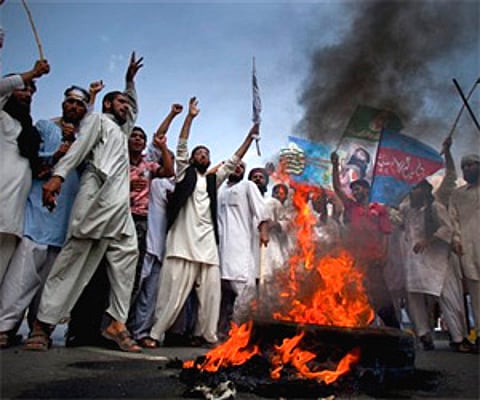
That event effectively blew the lid off Pakistan’s double-dealing and invited the wrath of the US establishment, including Congress, which is questioning the very value of the alliance. There is no doubt that this is an uncomfortable time for Pakistan.
Only time will tell if relations return to normal or the US finally calls time on an ally who has provided valuable service over the years.
Strategic Depth
Some Pakistani military strategists feel Afghan territory could provide a rallying point if an Indian attack cut through the country and divided it into two halves. In such a case, Afghan territory could provide “Strategic Depth” to regroup and counterattack. This idea also helps explain Pakistan’s interest in a “friendly” government that would allow the army to retreat into Afghanistan in order to gain strategic depth.
Dictators’ best friend
Although the US trumpets its support of democracy, in Pakistan its relations with civilian governments have always been tense.
Under Zulfiqar Ali Bhutto, for instance, relations between the two countries were particularly fraught because he had a different vision for his country, a foreign policy independent of US influence and dictated by Pakistan’s interest, especially in nuclear weapons policy after India’s Pokharan test of 1974. He came under great pressure to change his ways.
In 1976, US Secretary of State Henry Kissinger, in Pakistan for a meeting with Bhutto, threatened to “make a horrible example of you”. The next year, Bhutto was overthrown by General Zia-ul-Haq, who became America’s favourite Pakistani leader until his mysterious death in an aircrash in 1988. Bhutto was executed on April 4, 1979 after being convicted of the murder of a dissident politician.