
The protests against corporate lobbying in politics, the widening gap between the rich and poor, and the greed that caused the global financial crisis started with an editorial in Canadian anti-consumerist magazine AdBusters. Demonstrations are on in more than 70 cities across America, and several other countries.
In February 2011, staff writer Kono Matsu, calling for a protest along the lines of the Arab Spring, summarised the tactics used in Egypt and wrote, “If we want to spark a popular uprising in the West — like a million man march on Wall Street — then let’s get organised, let’s strategise, let’s think things through.”
In July, headed by editor Kalle Lasn, the magazine popularised the concept ‘Occupy Wall Street’ on Twitter, and printed a poster, showing a ballerina posing on the iconic Charging Bull on Wall Street. Word spread through other online media.
By September, a group had descended on New York’s bustling financial district, Wall Street, calling themselves the “99 percenters” — a reference to one third of American wealth being concentrated in the hands of 1 per cent of its population. As the movement spread to other cities, the demands of the protesters became a little clearer.
Who is Protesting?
While Kalle Lasn is probably the most-interviewed man on the subject of the protests, the movement prides itself on being leaderless and, therefore, truly democratic. Other groups such as the New York City General Assembly (NYCGA) and US Day of Rage, as well as Stop the Machine, have joined the protest, or organised similar demonstrations in other cities.
The people who have assembled to protest don’t fall into any one category — while there are several liberals, socialists and anarchists, there are a fair number of conservatives too. The enthusiastic early protesters were largely young, but now people of all ages have been seen camping out. Reports said people of diverse races, genders and religions had joined in.
Several celebrities have lent their voices to the protest. Tom Morello of Rage Against the Machine played at both Los Angeles and New York, and the band Radiohead has been vocal in its support too. Comedienne Roseanne Barr, filmmaker Michael Moore, actor Alec Baldwin, rapper Kanye West (who attended the protest in a $355 Givenchy shirt and $845 Balmain jeans), writers Salman Rushdie, Margaret Atwood and Naomi Klein, and commentators Noam Chomsky, Paul Krugman and Joseph Stiglitz have spoken in support of the movement.
What are the Protesters’ Demands?
Initially, AdBusters put forward one demand — a presidential commission to separate money from politics. But soon, Lasn announced that they were “setting the agenda for the New America.” Among the reasons cited by the demonstrators for the movement is disillusionment with Obama’s governance, especially his inaction against the “financial fraudsters” whom they hold responsible for the economic meltdown. However, the majority of the protesters are not against Barack Obama, but are calling for more effective controls in regulating the capitalist system. Many want an overhaul of the financial system itself, saying capitalism has failed the country.
The question of an agenda has become complicated. While some of the protesters want to put down a concrete set of demands, others are in favour of a general protest. There has been online discussion, asking for suggestions to add to the list of grievances. The lack of focus has been criticised in the media, with some reports hinting that the protest is a gimmick. However, a rebuttal was sent, saying the group was against the corruption, criminality and unrestrained political power that Wall Street stood for.
It has been more or less accepted now that Occupy Wall Street is a forum for people to air grievances about various aspects of governance, especially social and economic inequality.
What are the Protesters Doing?
First, the protesters set up camp in a private park, the Zuccotti Park, which was formerly known as Liberty Plaza Park, to start the ‘peaceful occupation’ of Wall Street. Police could not force people off the park, as it is not owned by the government, but by Brookfield Office Properties.
The protesters have since conducted marches, often disrupting traffic and getting arrested. With police outlawing sound amplifiers, the demonstrators came up with the “human microphone” system. Whenever someone makes a speech, those standing within earshot shout out his or her phrases in a chorus, so the rest of the assembly can hear what is being said. The protesters have been organised into ‘committees’, and two ‘general assemblies’ are held every day, for administrative decisions and announcements. Agreement with what is being proposed is signalled by wiggling fingers, an action that has come to be known as ‘twinkling’. The committees coordinate protest activities including media enquiries, legal recourse, security, food and medical provisions. Using laptops and accessing the Internet through wireless routers, sections of the protesters have been liaising with the media, and posting updates on Facebook, Twitter and Tumblr. They have also managed to bring out the Occupied Wall Street Journal, funded by donations.
Other groups have reportedly been handling cleaning up of the park; however, Brookfield Office Properties has been getting nervous enough about the hygiene situation to call in police to clear out the protesters for a while. But the eviction was postponed.
Supporters in the area have allowed protesters to use their bathrooms too. Some of the demonstrators have even made use of the facilities at the establishments they’re protesting against.
What are the Police Doing?
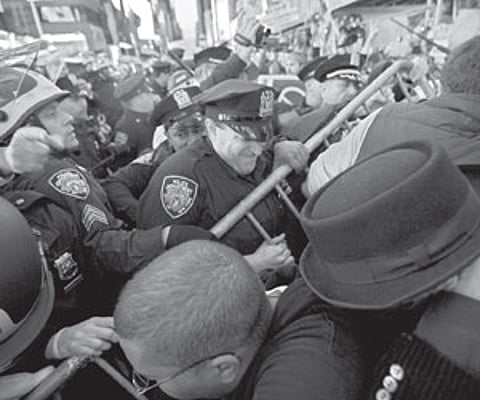
With a huge crowd to monitor, police officers have resorted to a technique called ‘kettling’. Orange nets are used to separate demonstrators and herd them into smaller group.
One of the officials, Deputy Inspector Anthony Bologna, got into trouble after videos of him directing pepper spray at a group of young women, and at a photographer, were posted online. An investigation into the incidents has been launched by the Internal Affairs and the Civilian Complaint Review Board.The controversy gained huge publicity and media coverage for the protest.
Role of Online Media
AdBusters coined a name for the movement by creating the Twitter hash tag #Occupy Wall Street. This was supported by the hackers group Anonymous, which called out to people to “flood lower Manhattan, set up tents, kitchens, peaceful barricades and occupy Wall Street.”
Meetup and Facebook were used to coordinate copycat protests in other cities, and even countries. Of these, the most high-profile is Occupy LSX, a group that intends to converge at the London Stock Exchange to highlight “unethical behaviour” by banks.
The slogan for the movement, “We are the 99%,” got its name from a Tumblr blog which posted anecdotes from regular Americans hit by the economic slowdown.
Reactions to Occupy Wall Street
A survey by Time Magazine, conducted on October 13, found that 54 per cent of Americans are in favour of the protest, while 23 per cent are not. Many in the vicinity of Wall Street have complained about the disruptive activities of the demonstrators.
President Obama said the protest was an expression of “the frustrations the American people feel” after the financial crisis. He defended the non-prosecution of Wall Street executives who may have triggered off the meltdown, saying their activities were not illegal, merely “immoral or inappropriate or reckless”.
Some Republicans have been sharp in their criticism of the protesters, saying they have only themselves to blame for losing their jobs.
Most foreign countries are noncommittal, expressing sympathy with the cause of the protests as well as understanding of the difficult political situation. But China, Iran, Greece, North Korea, Russia and Venezuela have criticised the economic and political system in the US.
