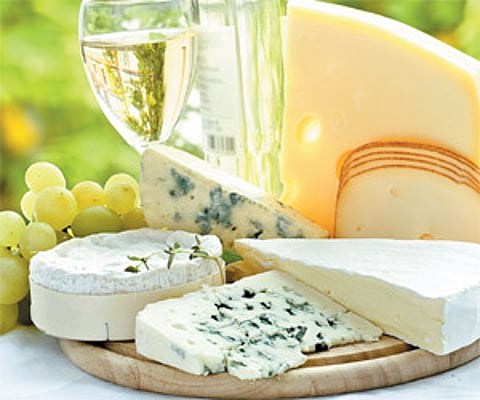

It took me a while to find an answer to this one out but when I did, I had a good laugh. So if you don’t know the answer (or even if you do!), the following paragraphs will tell you a lot about cheese, its origin, the different kinds, how you can make some at home and of course, the answer to the riddle above.
There are many varieties of cheese and these can be classified according to texture (hard or soft), aging (how long they are preserved for), process and method of making, fat content, kind of milk used (cow, buffalo, goat, or even yak and camel milk!) and finally the region or country it originated in.
In the Indian subcontinent, the traditional variety of cheese is called paneer. Historically, references to cheese have been made in The Vedas. Given the abundance and prominence of milk in India, as well as a predominantly vegetarian diet, cottage cheese has been a significant part of Indian cuisine and an important source of proteins. However, adoption of the word paneer is more recent.
It is the Persian word for cheese and the most popular variety we have in India was brought to India by the Mughals. It is prepared by curdling hot milk by adding lemon juice or vinegar and pressing the excess water out. The lovely white crumbly cheese is a good source of protein and is a part of many dishes — including some sweet ones like the syrupy and soft rosogulla or creamy ras malai!
Which brings us to another popular version of paneer called chenna, popular in Bengali and Oriya cuisine. Chenna is much softer and has more moisture than the regular paneer and it is beaten by hand before being rolled into soft balls. It looks and feels a lot like mozzarella cheese, the lovely gooey stringy cheese used to top pizzas.
Another popular cheese used in India, especially in sandwiches is Cheddar. It is a hard, salty and slightly tangy cheese, which finds its origin in England. A number of popular cheeses of the world come from the European continent, including France, Germany, Italy, Netherlands and Switzerland.
The holey yellow cheese that Jerry (of Tom & Jerry fame) always seems to be running after is the semi-hard Swiss Emmental cheese, made from cows’ milk. The many holes appear due to the carbon dioxide that stays trapped in the cheese while it is being made and processed. Some other varieties of popular international cheeses are Cheddar, Stilton (English), Parmesan, Mozzarella (Italian), Brie, Camembert (French), Feta (Greek) and Edam (Dutch).
Unlike paneer, the milk for these cheeses is curdled using the enzyme rennet, which is found in the stomach lining of calves. The enzyme serves the same purpose as the vinegar or lime juice. Irrespective of how they are made, traditional cheeses are rich in protein, calcium and fats (except the Dutch cheese Edam, which is low in fat). Some cheeses take weeks to make and some much longer. But there are also some that can be made quickly and easily — like the good old paneer — even you can make it (but with the help of an adult please).
The making of this cheese was quite straightforward, so what cheese is made backwards? Well, I will give you two hints. The answer is in the text above and the cheese is made in Holland.
Happy searching!