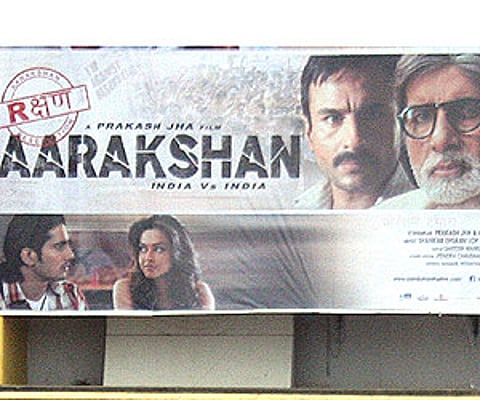

When the censors certified Prakash Jha’s film Aarakshan for release, he may have thought all the hurdles had been crossed. He was in for a rude shock. The Uttar Pradesh Government banned the film, as did Punjab, on account of its content. There were protests in Tamil Nadu as well, but the State government ruled out a ban and provided protection at theatres showing the film. A number of politicians and political parties condemned its alleged message and called for a ban. Yet another piece of entertainment had fallen foul of politicians, parties and social activists.
The film has received mixed reviews, but the fuss has nothing to do with its quality or its leading actors. The trouble may be due to the assumption that it is a criticism of the reservation system, which is central to the government’s efforts to level the playing field for the country’s most disadvantaged classes. In other words, its critics seem to think it is against affirmative action.
One review (at koimoi.com) contradicts this view thus:
“Prakash Jha’s story about the education system is an interesting topic... considering that the two aspects of reservation policy and commercialisation of education have not been dealt with together in a big-budget film earlier.”
The meat of the story is not about reservation per se, but about the commercialisation of education and the culture of paid tuition substituting for quality education.
As for the reaction, the review says: “Blame it on the title and the initial reels, in which the issue of reservation is highlighted, but... in the second half, the focus shifts to commercialisation of education... one feels that the film leaves the burning issue midway and changes tracks... once the track of coaching classes begins, the reservation policy issue seems to be relegated to the background.”
So why should a film that is more about the commercialisation of education than reservations cause a hullabaloo and lead politicians of all stripes — but especially those who claim to represent the disadvantaged — to condemn it and demand a ban?
The first reason of course is that reservations based on caste, degrees of backwardness and minority status are a sensitive subject because so many people and organisations feel so strongly about it. Reservation is one of the holy cows of Indian politics. No one can afford even to suggest a dilution without inviting political death. Even so, any time a discussion is proposed, the supporters of reservation leap to the defence of the policy.
The second and real reason could be the creeping intolerance that seems to have made its way into every part of public life. For instance, a couple of years ago the producer Karan Johar made Wake Up Sid, in which Mumbai was pronounced Bombay. Immediately, the Maharashtra Navnirman Sena, one of Mumbai’s most fearsome pressure groups, threatened to disrupt its showing wherever it could. Faced with the prospect of a no-show, and no help from the State government, Johar made an abject apology to its chief Raj Thackeray and changed to Mumbai. All objections were withdrawn.
This example could be multiplied many-fold. The Bangladeshi writer Tasleema Nasrin, fleeing the wrath of Islamists in her own country, came to India for sanctuary. She wanted to live in Kolkata, and Bengal’s avowedly atheist Marxist government agreed. But when the State’s Islamists began an agitation demanding her expulsion, it caved in, even though the Constitution protects freedom of expression, and the courts have given clear guidelines. Like Johar, Tasleema did nothing illegal, yet both were forced to bow to someone’s arbitrary notion of rightness. In the case of Jha, the Allahabad High Court has struck down the ban and ordered the UP government to let the film be screened.
A worse case in point concerns the Sri Ram Sene of Karnataka in January 2009. This right-wing organisation, functioning as a moral police, gatecrashed a bar in the city of Mangalore and dragged out and beat up some young women having a quiet drink inside. Again, they were not doing anything illegal, but the Sri Ram Sene members still tried to enforce their ideas of right behaviour.
The question raised by the Aarakshan row is simple; why should contrary opinions be allowed? The answer, too, is extremely simple. One, the Constitution permits freedom of expression, subject to some reasonable restrictions. So if someone does not like what the film says, they are free to express their dissent. But they cannot suppress its point of view. Secondly, India takes pride in being an open society, and integral to that concept is that everyone should be free to say or think what they like, even if it is offensive to some sections.
Whether aarakshan (reservation) is good or not is, really, besides the point, which is that if someone thinks it is bad they should be heard patiently. By definition, debate and discourse are central to an open society. Anything less is a disservice to democracy at best and a descent into thuggery at worst.
The Reservation Imperative
At Independence India was one of the world’s most unequal societies. In addition to disparities of wealth the caste system made inequality a religious requirement. The varnashrama dharma, as it is called, has meant generations of abjection and misery for the majority of Indians condemned to perpetual deprivation by religious belief and tradition.
So strong were these sanctions that despite thoroughgoing social revolts such as those of Basava and Guru Nanak caste flourished almost unaffected. Millions of Indians were untouchables until modern times (many still are), and that is why any perception that their protections may be weakened arouses such strong reactions.
The inequities thus created and perpetuated were so great that the Constituent Assembly announced a system of reservations for the most deprived. The Constitution (Scheduled Castes) Order, 1950 lists 1,108 castes across 25 states in its First Schedule, while the Constitution (Scheduled Tribes) Order, 1950 lists 744 tribes across 22 states in its First Schedule. These were the first beneficiaries of the reservation policy. The Constitution lays down general principles of affirmative action for these groups. The number of groups covered by reservation has since risen, especially after VP Singh’s government tried in 1990 to enforce the recommendations of the Mandal Commission’s 1980 report.
Parliament has passed a number of bills to enforce equality, provide punitive measures for transgressions, and to eliminate practices that perpetuate inequities. These include: The Untouchability Practices Act, 1955, Scheduled Caste and Scheduled Tribe (Prevention of Atrocities ) Act of 1989, the Employment of Manual Scavengers and Construction of Dry Latrines (Prohibition) Act, 1993.