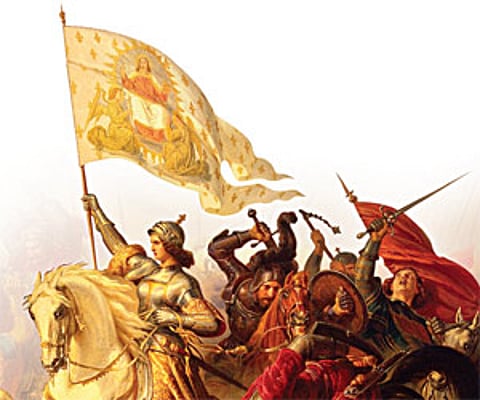

Saint Joan of Arc is considered a national heroine of France and a Catholic saint. A peasant girl who claimed divine guidance, she led the French army to several key victories during the Hundred Years’ War, which paved the way for the coronation of Charles VII. She was captured by the Burgundians, sold to the English, tried by an ecclesiastical court, and burned at the stake when she was 19.
She was born around 1412 in eastern France. A truce was in effect between England and France, but an internal war had broken out between two factions, which made it easier for England to reinvade France.
Joan testified at her trial that she experienced her first vision around 1424 at the age of 12, when she was alone in a field and saw visions of Saint Michael, Saint Catherine, and Saint Margaret, who told her to drive out the English and bring the Dauphin (Charles VII, the heir to the throne) to Rheims for his coronation. At the age of 16, Joan petitioned Count Robert de Baudricourt for permission to visit the Royal French court at Chinon.
Baudricourt refused to see her. A few months later the situation was fast becoming hopeless for Charles when Joan gained a second meeting where she made a remarkable prediction about a military reversal near Orléans. When news from the front bore out her prediction, Baudricourt decided to let her visit Chinon. She made the journey in male disguise. At the Royal Court she impressed Charles during a private conference when she is said to have assured him that he was the legitimate claimant to the throne.
However Charles first wanted her to be examined by a group of theologians to test her orthodoxy. At this time Charles’s mother-in-law Yolande of Aragon was financing a relief expedition to Orléans and Joan asked for permission to travel with them and wear the equipment of a knight.
She arrived at the siege of Orléans on 29 April 1429. Joan rejected the cautious strategy that had characterised French leadership during previous campaigns and led many successful campaigns in which her role would become typical; she was quoted as saying that she preferred to carry her banner into battle (rather than a weapon) since she did not want to harm anyone.
Eyewitness accounts describe her encouraging the troops to greater effort by placing herself in the same danger that they faced.
Soon the English positions fell to the triumphant French. After the Dauphin’s joyful reunion with Joan she insisted he go to Rheims to be crowned. They made it and during the crowning ceremony Joan stood near Charles holding her banner. She felt that what God wanted had now been accomplished.
After many more successful battles Joan was captured at Compiegne. She was brought to trial but no witnesses were called except the accused herself. An attempt was made to link her to witchcraft. Finally they managed to get a conviction and she was sentenced to be tied to a pillar and burnt.