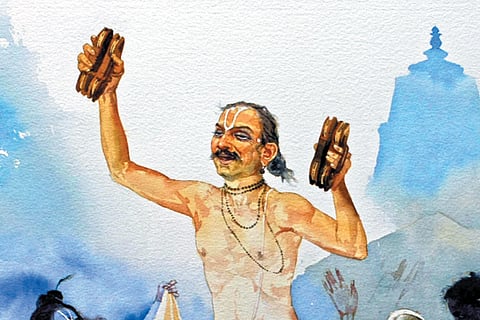

The British introduced the technique of using watercolours in art to India mainly to portray the pristine beauty of India. Several veteran artists like Abanindranth Tagore, Rabindranath Tagore, Benode Behari Mukherjee and Gopal Ghosh experimented within the medium, creating watercolours that were absolutely enticing in their simplicity. The transparency and delicacy of the medium not only imparts a fresh appeal to a work of art every time you view it, it is also a thing of everlasting joy and beauty. Yet in today’s age of new media and digital technology, younger artists are not very comfortable with this medium which needs great commitment and finesse to execute. Even at important art fairs across the country, large-scale installations, video art and new media works attract the most attention.
In such a scenario, it is heartwarming that there are still a clutch of artists who have remained loyal to watercolours. J J School of Art alumnus Vasudeo Kamath, for instance, feels that watercolours are best suited to bringing out the naivety of the ancient times. Kamath takes a spiritual approach in his work and portrays India’s ancient heritage by recreating the magic of dohas, abhangs and Marathi poetry by saints like Kabir, Tulsidas, Narsimh Mehta and Jana Bai.
Kamath believes that watercolour is such a transparent medium that in masterful hands, even the smallest nuances of what one wants to portray can come out beautifully. Unlike oils which take a lot of time to dry and need several coats to get the desired effect, watercolours give you only once chance. Another watercolourist, Anjani Reddy, is known for recreating the rural images from Indian villages in her work. Her female forms are a reminder of the simplicity and beauty that we have lost, so mired are we in the complexities of everyday life.
The female form, delicately carved, also surfaces in Vinod More’s work portraying different emotions and moods of a woman as she reclines against a couch. Taking inspiration from his birthplace, Nashik, Prafull Sawant has used the medium of watercolours to portray the ethereal ghats of the Godavari river and the landscapes of the temple town in which he resides. Sawant says that watercolour is a complicated medium in today’s instant age. The artist has to plan in advance the contrast of light and shadow and only those painters who have a clear concept of drawing can adapt to this medium.
But it’s not as if watercolours are only about things that are rustic and naïve. A strong statement about the current times has been made by Prabal Mallick in his watercolours that feature a series of three cows in different colours. Making a comment on the division of social structure of the world — the haves, the working class and the have nots, he has ably created the analogy between his animal forms and the world at large through his anatomically strong works. Mallick has given up other mediums to paint in watercolour for the last four years and says, “I will do so for the rest of my career as an artist!”
(Poonam Goel is a freelance journalist who contributes articles on visual arts for unboxedwriters.com)
