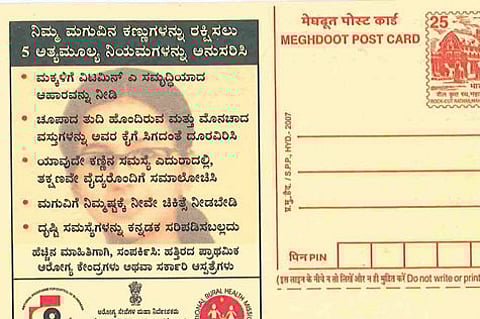

A few decades ago, hardly any day would go by without the postman bringing post from family or friends. One used to wait anxiously for the postman bringing some important message written in the ‘cream coloured post cards’ or inland letters. They were the only means of written communication.
A post card was one of the cheapest and open forms of conveying information. For the common masses, they were the most affordable means of communication.
Costing a mere 10 paise back in the days, they are priced at 50 paise today while the Meghdoot Post card is much cheaper at 25 paise. But, despite all these, why is it that only a few people use this service ? In this 21st century, the present younger generation is highly influenced by smart phones, ipads, e-mail, chatting, SMS and of course, the Internet.
The advent of mobile phones has also grabbed the attention of the youth and even the new born babies. Nowadays, within a few seconds, messages can be sent to people all over the world.
Perhaps in this age of instant communication, do people still need post cards? A HR executive, Nisha told City Express, “I can’t imagine using a post card as they are too slow and messages cannot be delivered instantaneously. Earlier, when I was around 10 years old, I used to write in a post card to my uncle but that is a forgotten chapter today.”
Another professional, Sundar said, “I have never used post cards in my life. It is irrelevant in today’s fast paced world. In the olden days, it was relevant and used frequently.”
City Express did a reality check and found that there were hardly any users of the ubiquitous post cards by today’s generation.
However, the older generation still had fond memories of the Dakhiya Dak laya.
Gopalakrishna, a bank employee said, “Until recently, we were using post cards but since the advent of computers, the usage has declined.”
However, a retired employee from Central Excise department, Umesh said, “The present day communication forms are costly and a common man especially in the rural areas cannot afford internet and the mobile phone and therefore, even today, many people use post cards for communication.”
Commercial viability
Contrasting to this, many organisations and institutions use post cards for business and marketing purposes. It really works cheaper when they need to communicate to a bulk of their consumers, customers, listeners, readers and viewers. They can either send official or personalised messages.
Marketing post cards can also be personalised for special occasions such as holidays, birthdays, parties and special offers. An individual or organisation can also print cards for their staff or consumers.
Bhavani, working in a local Kannada newspaper said, “People write to us for events, engagements, cultural and spiritual programmes, letters etc to be published in our paper. We receive more than 40 post cards, but it may sometimes even increase upto 80 per day.”
However, according to a leading English newspaper, usually a minimum of 15-20 post cards are received daily.
An official from the Ciy Postal Department said, “The sale of post cards has never really declined. Around 5,000 to 10,000 post cards are sold daily. On an average, about two lakh cards are disposed every month. Apart from that, we also sell printed post cards at Rs 6 each and Meghdoot post card at just 25 paise.”
History of Indian postcards
Postcards were introduced for the fi rst time by the Indian Post Offi ce in July 1879. The cost was only quarter anna. This was to provide postage from one place to another in British India.
They set up a large postal system in India which resulted in postal access to everybody where in a message could be sent from one part of the country to another without additional postage affi xed.
Even today, this facility continues in independent India. Post cards are of two varieties such as : Printed and Meghdoot cards.
Messages recorded by printing or cyclostyling are classifi ed as printed post cards. The writing space available on the left hand side of the address which is availed for advertising in single colour or multi-colour of a post card is called Meghdoot. The advertisement can bear pictures and messages.