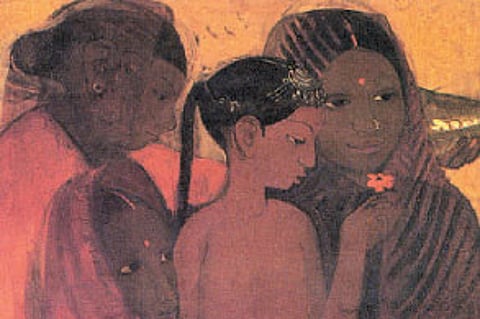

She lived to be only 29, but Amrita Sher-Gil, born to a Sikh aristocrat and a Hungarian mother in Hungary, is till today revered not only as a woman of substance but also one of India’s most reputed artists.
Amrita was barely 16 when she left to study art in Paris and her independent streak was visible from a very young age. In 1936 she mentioned in an article in The Hindu that, “Although I studied, I have never been taught painting… because I possess in my psychological makeup a peculiarity that resents any outside interference.” It was in Paris that she wrote a letter about how she began to be haunted by an intense longing to return to India, feeling in some strange way that there lay her destiny as a painter.”
When she returned to India as a 21-year-old, she carried with her the memories of the political and social turmoil she had witnessed in Paris. It was this melancholy that got transferred to her canvas when she set foot on Indian soil for the first time in November 1934. Haunted by the faces of unhappy and starving Indians, whom she saw first around Shimla, the fashionable summer capital of the British Raj, then in the southern India and finally in Punjab, where she was to spend the last days of her life, she began painting poor people, whom she gave sad eyes and vacant stares, creating an air of utter hopelessness. Though she was often criticised for her European sensibilities and for not portraying elements from the independence struggle that India was going through at that time, Amrita was not just another foreigner enticed by Indian exotica. She was always an Indian at heart and despite her training in western art, had complete awareness of and deep respect for India’s artistic traditions.
Most of her paintings portray extremely thin, emaciated, starving men and women and all figures painted by her, especially those of women, have lacklustre eyes, an expression of resignation and despondency writ large on their drawn faces. The tragic melancholy in her earlier works, however, gradually became more detached and de-romanticised, such as in paintings of women in the Indian feudal setup and her canvases blossomed with studies of womenfolk and their cloistered existence.
While Amrita’s work largely involves landscapes, portraits and myriad scenes from village life, she is mostly remembered for her female forms. She was influenced by the freshness of the Ajanta and Ellora caves, the Cochin murals and the angular lines in the Kushan period sculptures she saw in Mathura. At the same time, Amrita is known to have been fascinated by Indian miniature paintings, especially those of the Basholi School.
One of her most famous series of three works — Bride’s Toilet, Brahmacharis and The South Indian Villagers — reveal her passionate sense of colour and an equally passionate empathy for her Indian subjects. She achieved that perfect blending of western techniques and Indian spirit, and thus laid the foundation of modern Indian art.
(Poonam Goel is a freelance journalist who contributes articles on visual arts for unboxedwriters.com)