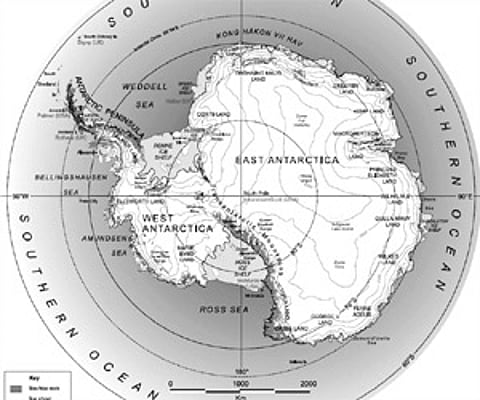

A couple of weeks ago, on February 5, 2012, a team of scientists from Russia announced that they had pierced the ice shield around a sub-glacial lake by digging 3,768 metres into the East Antarctic Ice Sheet. The largest of more than 140 lakes they drilled into was named Vostok, after Russia’s Vostok Station at the southern Pole of Cold beneath which the lake was found. Incidentally, the station itself is named after a warship used by Russian explorer Admiral Fabian von Bellingshausen to sail to Antarctica. ‘Vostok’ is Russian for ‘East’.
The lake is located about 500 metres below sea level, and is believed to have been sealed for between 15 and 25 million years. When the Antarctic summer begins at the end of the year, scientists hope to send in a robot to collect samples from the lake, as well as sediment from its bottom. They hope to find a thriving ecosystem in the waters of the lake.
Even otherwise, analysis of the water could provide valuable information about climate change over the past 400,000 years or more. This kind of study, known as ‘paleoclimatology’ is important, because changes that took place in the environment ages ago and the biodiversity they triggered off may indicate future trends if a similar situation were to occur.
How was Lake Vostok discovered?
The idea that a lake may be hidden under the Antarctic ice sheets was posited in the late 1800s by Russian scientist Peter Kropotkin, based on the theory that the pressure exerted by the heavy ice sheets would increase the temperature in the bottom layers, causing the ice to melt.
In 1959 and 1964 the Soviet Union conducted two expeditions into the Antarctic to measure the thickness of the ice sheet. Russian geographer Andrey Kapitsa said there could be a sub-glacial lake in the region, after studying seismic records from these expeditions. Research into this went on for decades, until British scientist Jeff Ridley confirmed the existence of the lake in 1993.
In 2005 and 2006 scientists found an island in the central part of the lake, as well as several sub-glacial lakes. These lakes were thought to be connected by sub-surface rivers. Russian scientists recently began to drill into the ice sheet to reach these lakes, and finally penetrated up to Lake Vostok.
Significance of the lake
The sub-surface rivers continually transfer water from one sub-glacial lake to another, when the pressure builds up, forcing water to break through the ice sheet. Now, this means that there is a tremendous amount of information about the climactic conditions of the earth over the past 15 million years or more.
Isotopes found in the water could indicate how and why sub-glacial lakes are formed.
The lake contains very high concentrations of oxygen and nitrogen, which means there is scope for various kinds of life. Certain micro-organisms have already been discovered in the lake, but these are of a species already known to exist on the surface. However, there is a chance that many more may be found, due to the varying temperature of the lake, despite the low nutrient availability and absence of sunlight.
But many environmentalists are not in favour of the scientists’ decision to drill through the ice sheet into the lake.
Why is the drilling controversial?
Drilling involves boring through the ice sheet, and then pumping in Freon and kerosene in order to prevent the tunnel from freezing again. There are worries that this antifreeze, of which about 60 tonnes will be used to fill the boreholes, could contaminate the lake.
While scientists are excited by the possibility that ancient bacteria, with a gene pool dating back half a million years, could be discovered ecologists are concerned that the chemicals could severely damage this delicate ecosystem.
Environmental groups have been asking the scientists to use hot-water drilling instead, but the team said this would not be possible because that would require more power than could be generated at such a remote camp. The US and Britain are also in favour of the hot-water drilling procedure, or waiting until alternative clean technology becomes available.
The Russian team said new equipment has been developed by researchers at the St Petersburg Nuclear Physics Institute that would stop the lake from being contaminated. They also said they would switch to a new thermal drill head with a ‘clean’ silicone oil fluid about 50 metres from the surface of the lake.
A final decision is yet to be made on drilling further. Several countries are in favour of drilling into a smaller lake first, as an experiment.
