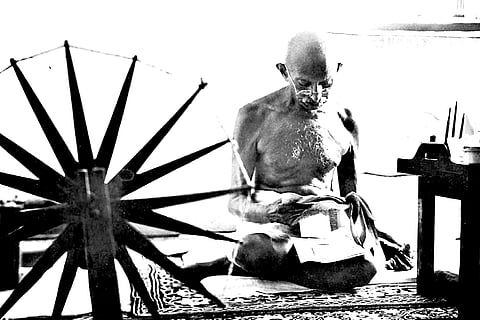

Enough has been written about Mahatma Gandhi, his beliefs, his passion and his movement which forced the British out of the country. Some of his thoughts are projected best through his own works, especially his autobiography, My experiments with Truth. It can be rated as one of the most popular and the most influential books in the recent history.
Mahatma Gandhi’s autobiography, 'Sathiya Sodhani', written in Gujarati and later translated into 'My experiments with truth', is one book which guides you as to what is right and wrong. Most importantly, the author should have experienced all these.
The book is in five parts, beginning with his birth, up until the year 1921. In the last chapter he writes, “My life from this point onward has been so public that there is hardly anything about it that people do not know...”
The introduction reads, “What I want to achieve - what I have been striving and pining to achieve these thirty years is self-realisation, to see God face to face, to attain Moksha. I live and move and have my being in pursuit of this goal.”
It was written at the instance of Swami Anand. It appeared in the Weekly ‘Navjivan’ during 1925-28. It covers Gandhi’s life up to 1920. He did not cover the period after that as it was well known to the people and most of the concerned persons were alive. Besides he felt that his experiments in that period were yet to yield definite conclusions.
In the book’s introduction, Gandhi states ‘a God-fearing friend had his doubts, which he shared with me on my day of silence. ‘What has set you on this adventure?’ he asked. ‘Writing an autobiography is a practice peculiar to the West. I know of nobody in the East having written one, except amongst those who have come under Western influence. And what will you write? Supposing you reject tomorrow the things you hold as principles today, or supposing your revise in the future your plans of today, is it not likely that the men who shape their conduct on the authority of your word, spoken or written, may be misled? Don’t you think it would be better not to write anything like an autobiography, at any rate just yet?’
This argument had some effect on me. But it is not my purpose to attempt a real autobiography. I simply want to tell the story of my numerous experiments with truth, and as my life consists of nothing but those experiments, it is true that the story will take the shape of an autobiography. But I shall not mind, if every page of it speaks only of my experiments.’
There are many other books which reflect his thoughts in a detailed manner. Hind Swaraj, the title of the first definitive writing of Mahatma Gandhi, and which continues to evoke critical interest the world over even now, literally means ‘self-rule in India’.
This small book of about 30,000 words was written in Gujarat in November 1909 on board the ship during Gandhi’s return trip from England to South Africa after an abortive mission. As stated by Gandhiji himself: “I wrote the entire Hind Swaraj for my dear friend Dr. Pranjivan Mehta. All the argument in the book is reproduced almost as it took place with him.”
It was published in the Indian Opinion in Natal and was soon banned by the Government in India because it contained ‘matter declared to be seditious’. On that, Gandhi published the English translation from Natal to show the innocuous nature of its contents. The ban was finally lifted on 21 December 1938.
Key to Health, which was published in 1948 is a small and concise booklet on health. Gandhi who wrote it in Gujarati and Sushila Nayar who translated it in English is to be commended for both, the choice of the topic and its lucid presentation.
This book is welcomed by common medicine enthusiasts and students, alike. Gandhi wrote these chapters while he was confined in the Agakhan Palace at Poona during 1942-44. By writing this book, Gandhi wanted to convey to his people and to the world, the vital question of Health. To him, a study of this question was part of the service of God and his creation, which was his mission.
'All Men Are Brothers: Life & thoughts of Mahatma Gandhi as told in his own words' was compiled & edited by Krishna Kripalani. It is a compelling and unique collection of Gandhi’s most trenchant writings on nonviolence, especially in the context of a post-nuclear world. This compendium, which reads like a traditional book — Gandhi without tears — is drawn from a wide range of his reflections on world peace. It was first published in November 1960.
'Epigrams from Gandhiji', compiled by S R Tikekar is a collection of pithy sayings of Mahatma Gandhi on various subjects and important issues for rapid reference. The compiler has selected a few thousand epigrams from Gandhiji’s voluminous writings. The epigrams have been arranged alphabetically and the source of each epigram is given below it.
'Ethical Religion by Gandhi' was published in 1907 followed by The Bhagavad Gita according to Gandhi in 1929, which was based on talks given by Gandhi between February and November 1926 at the Satyagraha Ashram in Ahmedabad. During this time, a period when Gandhi had withdrawn from mass political activity, he devoted much of his time and energy to translating the Gita from Sanskrit into his native Gujarati. As a result, he met with his followers almost daily, after morning prayer sessions, to discuss the Gita’s contents and meaning as it unfolded before him. This book is the transcription of those daily sessions.
Another book on Gandhi’s philosophy expostulated in his own words on various topics like truth, peace, fearlessness, love, non-violence, vegetarianism... amongst 96 others, is available under the title The Mind of Mahatma Gandhi — an encyclopedia of Gandhi’s Thoughts.
The Moral Basis of Vegetarianism was written by Gandhi and published in 1959. The book is a compilation of Gandhi’s writings on vegetarianism. This work includes eight chapters on Food values, vital need for research, the moral basis of vegetarianism, our daily diet and minimum diet.
Gandhi’s views on this subject are presented well in this booklet and remain relevant to those interested in adopting a simple and healthy diet.
'The Words of Gandhi' volume includes an introduction by Richard Attenborough and an afterword by Time magazine Senior Foreign Correspondent Johanna McGeary that places Gandhi’s life and work in the historical context of the twentieth century.
This book and the film 'Gandhi' were the result of producer/director Richard Attenborough’s long commitment to keeping alive the flame of Gandhi’s spiritual achievement. They are the wisdom and words of peace. Also included are twenty striking historical photographs, specially selected from the archives at the National Gandhi Museum in New Delhi, that capture the important personal, political, and spiritual aspects of Gandhi’s career.
Towards New Education, written by Gandhi and edited by Bharatan Kumarappa was published in 1953, gives a picture on the evolution of Gandhiji’s ideas with regard to education.
An Atheist With Gandhi by Gora (Goparaju Ramachandra Rao) is the result of Gora’s long discussions with Mahatma Gandhi on atheism and social change.
Gandhi — His Relevance For Our Times, edited by G Ramachandran and T K Mahadevan, the careful reader will find much new ground being uncovered before his eyes and many incentives to new thinking. If the burden of the book is that Gandhi is intensely relevant to our times, it makes this assertion not dogmatically but with the humility of scientific exploration.
The Making of a Social Reformer: Gandhi In South Africa, 1893 - 1914 was written by Surendra Bhana and Goolam H Vadeh. Gandhi’s assassination has also generated many book ideas. The murder of the Mahatma and other cases from a judge’s notebook was written by G. D Khosla and published in 1968, while Spitting at the sun — Assassination of Gandhi: Facts vs. Falsehood was published in 1998 by Chunibhai Vaidya (translated from Gujarati — Sooraj Saame Dhool: Gandhinun Balidan Ane Sachun Shun Khotun Shun).
The book document facts, centering round the assassination of Gandhi. Reference: http://www. mkgandhi-sarvodaya.org/ booklist/bk123.htm http://www.gandhimanibhavan.org/eduresources/ eduresources_ booksbygandhi.htm http://www.mkgandhi. org
