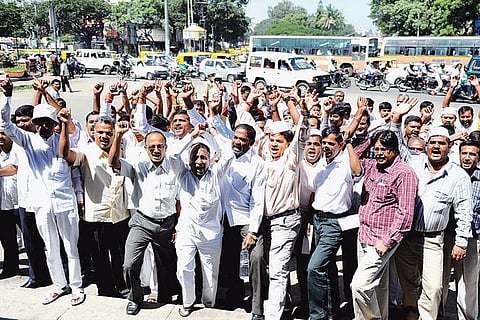

'Itna sannata kyun hai bhai?' This iconic dialogue by A K Hangal will hit the right chord (hoping that the bandh is peaceful) once again today, when Karnataka goes for the 'bandh' called in protest against the Supreme Court directive to release Cauvery waters to Tamil Nadu.
It had hit the chord before when Bangalore came to a standstill on 20th of last month, thanks to FDI.
The city's mobile population had shrunk to hundreds from millions, the roads breathed easy, the pollution levels came down drastically, the birds flew wonder struck, children were joyous, so were husbands and wives.
On the other hand, KSRTC and BMTC sulked, CII, NASSCOM, FICCI started calculating the losses, daily wage labourers prayed for the day to be over, industry and shop owners mourned the losses.
At the end of it all, two aspects of a bandh come to fore.
There is a lasting economic loss and there is a short-term independent gain.
Thankfully, the city and the state has seen bandhs not exceeding a day.
It is in public domain that outside of a particular corporation or PSU, most strikes have political backing.
It is also in common knowledge now that unlike Kolkata, Bangalore is quite lucky in terms of the grave economic loss, but the city does begrudge Kolkata.
Definitely a 'city of joy' because for what is claimed to be a city which witnesses nothing less than 40-50 bandhs in a year, the families are happy and so, is the environment.
According to the former chairman of Karnataka State Pollution Control Board (KSPCB), A.S. Sadashivaiah, though the economy of the state is drastically hit by such bandhs, it does have its positive effect on the environment.
He says, “There is a tremendous drop in the pollution level when there is a bandh. Recently, during the Bharat Bandh, Bangalore vehicular pollution level went down by 30- 40 per cent. Otherwise also, Bangalore witnesses sharp decrease in pollution levels during weekends and also during Bus Day, the initiative started by BMTC.” But then the negative impact does have its incommodious overtones.
Postponement of exams, cunctation in patients getting treatment or ambulances, tourism industry losing business, apart from huge revenue loss.
The concept of bandh when it began initially as a strike action rising from a papyrus preserved in a turin way back in 1152 BC in ancient Egypt may have been laudable.
Common people, who felt that they were being pushed down, getting together armed with just an aggression fuelled by frustration and need, was an idea that showed the strength of unity without any power.
It came to fore with much worldwide attention through Mahatma Gandhi and his peaceful protests that even kneeled down a mighty empire.
But over the years, the protests have seemingly turned violent sparked by vicious circles that tend to use methods of destruction to garner more attention.
Today, bandhs and violence seem to inescapably go hand in hand.
In the midst of unemployment, rising inflation, high stress levels, growing population, underdeveloped infrastructure and the many adverse factors that are part and parcel of our lives, such actions of violent bandhs can only escalate the unfavourable aspects of life.
The youth, especially who are always at the forefront on such days, resorting to violence are often seen enjoying themselves when throwing stones or setting buses on fire.
A classic case of immaturity; understanding their ignorance is by default seen as our maturity.
As for industries, all they can now do is batten down the hatches.
KS Viswanathan, Vice President, NASSCOM says, “Any disruption in normal life causes problems, but in terms of IT companies, when such bandhs take place, they usually have a plan B and Plan C.
This is especially true in neighbouring states where bandhs have been on the rise.” According to K Shiva Shanmugam, president, Federation of Karnataka Chambers of Commerce and Industry (FKCCI), there was a loss of over Rs 1,200 crore on the turnover and the state exchequer incurred a loss of Rs 200 crore during the Bharat Bandh on September 20th.
“The loss estimate springs up from Rs 80,000 crore that is annually collected as VAT and other forms of direct taxes from the state.
Of this, Rs 30,000 crore per year is collected from VAT and ` 50,000 per year approximately from direct taxes.
” Confederation of Indian Industry (CII) release said that the last bandh had been disruptive for business and trade in many parts of the country.
The release further said that 'though an exact loss for the entire economy is not known, it can be estimated that almost Rs 12,500 crores has been the loss to the country in terms of disruptions in production and trade.
“We do not keep track of the losses, but if the bandh persists for a few days, then definitely it will have its effect in terms of revenue loss in the long run,” said Viswanathan.
According to Shanmugam, FKCCI respects the bandh on October 6th, but the issue should be settled amicably rather than making a political issue out of it.
He says, “I think the loss from the October 6th bandh will be to the tune of Rs 1000 crores. I also feel that while the agriculture and industry has to grow in some notches in the state, there has to be a third dimension which needs to be addressed which is the alignment of people's thinking. But in the current juncture, we accept the protest. We cannot do much because after all it is the apex court order.” But ironically, in 1998, it was the Supreme Court which had banned bandhs across the country! So, what is the best way to show their disrespect to the order give by the apex court - Bandh.
