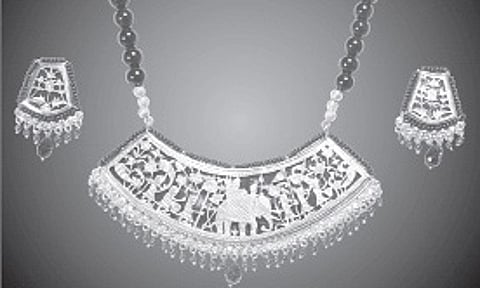

Thewa, the 400-year-old art of jewellery designing has its origins in Rajasthan. The basic Thewa jewelry is made on a mottled sheet of pure gold which is then combined with coloured glass which constitutes a single unit. This entire range of jewellery is handmade and sometimes a single piece of jewellery takes more than a month to design. The glass that is blended with the gold, is treated with a special process which renders a dazzling effect and in turn highlights the gold patterns.
It started under the patronage of Maharawat Samant Singh in the Pratapgarh district of Rajasthan. Thewa, which means “setting” in a literal sense, is a unique way of fusing gold and colored glass to create magnificent pieces. The invention of this at is credited to Nathu ji Soni, whose family kept the craft a secret to be passed from father to son only. It is said that the same family has been practicing the art ever since it was invented and the secret still remains with them. They call themselves “Raj-Sonis” now and some of their family members have received awards from the Government and also from UNESCO. To motivate this form of art, the Government of India issued a postage stamp in the year 2004 commemorating Thewa. Thewa continues to be an inimitable form of art because of the amount of labor, craftsmanship and detail that goes in the making of a single piece of jewelry.
Over a period of time, the makers of the jewelry have come up with customizations to the traditional way of crafting a Thewa piece. Thewa is now being combined with the Kundan art which is again a traditional art of jewelry and adds another dimension to the original Thewa. The method of preparing Thewa jewellery is time consuming, exhaustive and grandiose due to the complexity and delicacy involved. One piece can take over months for the craftsmen. This process starts when fragments of terracotta are smashed and combined with certain chemicals and oils to prepare a dense paste. This paste is then spread on a timber board post which, gold sheets of about 23 carat purity and of a certain thickness is set onto this paste. This gold sheet has a design impressed on it.
It is then covered in dark paint so that the design is visible and can be stenciled easily. Additional gold is removed later.
The coloured glass is initially treated to give it a glittering effect so that the gold work once merged, looks even more extraordinary. Coloured glass is actually the base which acts as a unit for the gold. The glass in the ornament is suggestive of semi-precious stones such as sapphire, emerald and ruby. Finally, a gold foil is attached onto the base and the unit is then mounted onto a silver foil separately; after all is done, the unit is made into a piece of jewellery. Thewa jewellery comes in varied shapes like round, oval, square or rectangular and all shapes are equally radiant and alluring.
The designs in the Thewa jewelry are inspired from Hindu mythology. They also narrate the folklore of courage and romance in the form of visuals. Depiction of nature is again a common choice for the base design. The themes are innumerable, ranging from historic scenes involving famous battles to portraits of rulers or even the Indian gods such as Lord Krishna.
A lot of motivation also comes from the flora and fauna which renders a lively touch to the jewelry. In general, Thewa resonates with the rich heritage and culture of Rajasthan. It owes it colorful and vibrant nature to the themes chosen from life, nature, history and myth. Thewa is hence, more than a beautifully designed piece of ornament; it is a way of life for many.