
Dunkirk was one of the key operations of World War II which is seen as a watershed moment. In the early summer of 1940, British, French and Belgian troops were cut off and cornered by the German army on a tiny stretch of French coastline. There seemed to be no way out and it almost seemed certain that the war was about to come to a very abrupt end. Hitler’s stormtroopers and their blitzkrieg tactics had steamrolled through the Low Countries and northern France at lightning speed, and now appeared to have the British Expeditionary Force at their mercy.
However, a rescue plan hatched in Dover castle resulted in a victory being snatched from the hands of defeat. Between May 26 and June 4, 1940, almost 3,40,000 stranded allied troops were swooped up from the beaches of Dunkirk and escorted to the safety of mainland Britain, which at that time was the lone non fascist country in a Europe infected with Fascism.
Prime Minister Winston Churchill, who had assumed office just a few weeks prior to this incident, described the fall of France as a huge military disaster. But he praised the evacuation of the allied troops at Dunkirk as ‘a miracle of deliverance’ which utilised hundreds of little ships that successfully ferried 3,38,000 Allied soldiers to safety.
There was less than a week to prepare for this daring operation, codenamed Operation dynamo and the challenges were immense.
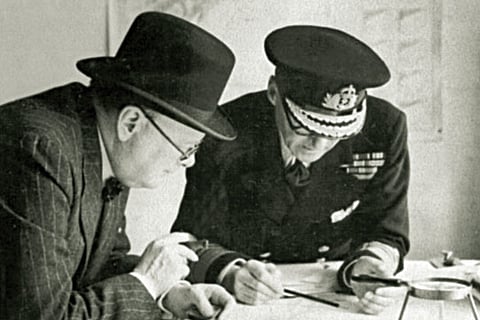
Vice Admiral Sir Bertram Ramsay steered the operation from the precincts of the Dover Castle, the largest fortification in Great Britain, which has been described as the ‘key to England’ due to its defensive significance throughout history. Historians contend that without Dunkirk, Britain wouldn’t have had an army and couldn’t have fought overseas, so it was extremely questionable whether Britain could have fought the war if the stranded soldiers had not been rescued.
Adolf Hitler’s decision on May 24, 1940 that German tanks should not advance towards Dunkirk on the Channel coast proved to be a huge stroke of good luck for the troops.
Instead, the Luftwaffe was assigned the task of destroying the hundreds of thousands of British troops who had fallen back on the port because of the swift German advance through France. If Hitler had ordered the tanks towards Dunkirk then Britain would certainly have lost the war within days.
Thankfully, the Luftwaffe could not manage to wipe out the British troops whose extraordinary evacuation was credited to the Royal Navy and the civilian sailors who manned the ingenious rescue armada, the ‘little ships’.
When the German soldiers finally made it to the Dunkirk beaches on June 4, 1940, they were greeted by devastation all around. corpses lying on the sand, a beach soaked in blood, burned-out ships, decaying horses, charred lorries and scattered items of clothing could be seen.
However, there was not a not a living British soldier in sight since all of them had been spirited away to safety 24 hours earlier, a miraculous feat considering that only a few days earlier, the British generals had been predicting a disaster.
What should never be forgotten is that the bulk of the British Army would never have escaped had it not been for the valiant soldiers who stayed behind to hold back the advancing Germans and buy their comrades valuable time.
This was truly a tale of unflinching courage and sacrifice. The men who stayed behind were the forgotten heroes of Dunkirk.
A marble memorial of the battle stands at Dunkirk (Dunkerque in French). It translates in English as: “To the glorious memory of the pilots, mariners, and soldiers of the French and Allied armies who sacrificed themselves in the Battle of Dunkirk, May–June 1940.”
The term “Dunkirk Spirit” still refers to a popular belief in the solidarity of the British people in times of adversity.