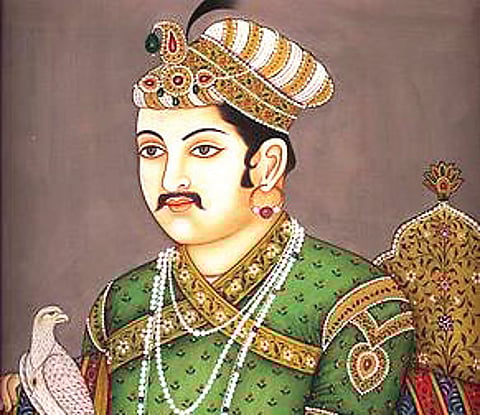

On January 26, 1556 the Muslim evening call to prayer was sounded and Humayun, the second emperor of the Mughal dynasty, started to descend the stairs from the terrace of his library. As he did so, his foot got caught in the folds of his cloak and he toppled headlong down the steps. Within hours, the kingdom was conveyed the sad news that king Humayun had drunk of the last cup from the hands of the Angel of Death.
The legacy bequeathed to his young son Akbar by Humayun was as uncertain as the one that was bequeathed to Humayun himself 26 years earlier. Akbar was only 14 the year Humayun tumbled to his death and in accordance with the last wishes of his father, he was placed under the guardianship of the Persian general, Bairam Khan.
Bairam Khan had been a faithful ally of Humayun during the long hard years of his exile when he had been overthrown by Sher Shah. Now with Humayun gone and Akbar still a minor, Humayun’s faithful soldier became the recipient of a strange and an unexpected
reward — the interim rulership of an empire. So, while Bairam Khan signed documents and waged war throughout India, apparently relishing his new role, the genuine heir, Akbar was quite oblivious to the situation and passed his days playing games.
Young Akbar invented card games, played chess and polo, wrestled, hunted, tamed wild elephants and stalked tigers in the central Indian jungles with whittled spears and poisoned arrows. Akbar was so immersed in sports that it was said that the best tutors of the palace could not manage to teach Akbar even the alphabet.
However, by the time Akbar turned 18, realisation started to dawn on him of the pressing need to claim his legacy. First, he unseated Bairam Khan and sent him on a pilgrimage to Mecca from which the old soldier never returned. Maham Anaga was Akbar’s foster mother who was now the only person to whom Akbar was beholden. However, when he discovered that she and her son had been plotting his dethronement, his reaction was swift and brutal.
Akbar threw her son off a balcony and when he survived the fall, he dragged him up the stairs by his hair and threw him off again. Maham Anaga was said to have died of grief thereafter. With two important rivals disposed of, and much to the consternation of the conservative royal council, Akbar then took full command of the empire. Within three years most members of the council had gone and Akbar began a programme of legislation. Although his two-generation old kingdom was immature and unshaped, Akbar had a clear vision of a united India, and was very ambitious like his predecessors.
The most farsighted of his reforms was the exemption of Hindus from the taxes and indignities that had harassed them for centuries in Muslim-controlled North India. Then as now, India was essentially a Hindu nation, and the Muslim invaders who had come in 712 AD had gained control over but never got the allegiance of the Hindu majority. Akbar realised that the Hindus were a potential ally. In 1564, he outlawed the desecration of Hindu temples, rescinded the jizya, a humiliating poll tax on non-Muslims and banned degrading policies such as the right of a Muslim magistrate to spit in the mouth of a Hindu who was late in paying his taxes.
Although Akbar did not hesitate to wage war against the Hindus who defied him, he placated the rulers he conquered by elevating the Rajput kings to high public office posts, rewarding them governorships and sometimes cementing the partnerships further by marrying their daughters.