
The Aztec civilisation was known for its fabulous wealth as well as sophisticated urban planning and administration. However, the Aztec tradition of mass human sacrifices revealed the brutal side of the civilisation. When the Spanish adventurer Cortes and his band of treasure seeking men pillaged and brutally annihilated the Aztec empire, the Aztecs met their match in brutality. Today, historians wonder who was more brutal — the Aztecs, or the 300 Europeans who annihilated them?
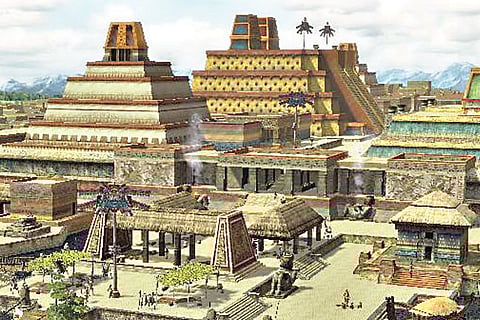
When the battle-hardened, armour-clad soldiers and the Catholic monk who accompanied them first laid eyes on the Aztec city, they were struck speechless with amazement. Rising out of the waters of the vast lake before them was a majestic island-city of wide streets and white stucco-fronted houses. Palaces and temples towered into the clear blue sky against a backdrop of snow-covered mountains.
These gold–seeking Spanish explorers from the other side of the Atlantic had expected to find an ordinary settlement of mud huts when they landed on this foreign shore more than 5,000 miles from home. Instead, what they found in November 1519, gleaming in the winter sunlight, was the magnificent capital of the rich and thriving Aztec civilisation. This immensely wealthy city was called Tenochtitlan and it was larger than any place that the Spaniards had ever come across. It had a population of more than 2,00,000 and it was bigger than London, Madrid and Rome put together. As the Spanish captain, Cortes, and his conquistadors (Spanish for conquerors), rode in procession through an arrow-straight causeway into the city, there were more amazing sights in store for them.
Venice-like canals criss-crossed the city, artificial gardens floated on the water and man-made dykes protected the streets from flooding. In stark contrast to the crowded, rubbish and excrement-strewn cities in Europe, this place was pristine. Sweepers kept its streets clean, there were public bathing places and lavatories made from reeds or straw.
In the marketplace, gold, silver and precious stones such as the blue-green turquoise, jaguar skins and brightly-coloured parrot feathers were traded.
Food of all types was plentiful, including tobacco and a heady alcoholic potion made from cactus juice. Cocoa beans were mashed into chocolate to make a potent bitter-sweet beverage that was highly addictive. It was served cold and frothy in small, gold cups and reserved for the royal family, noblemen and warriors. Presiding over this sophisticated civilisation was the imposing figure of the god-like Aztec ruler himself called Moctezuma or Montezuma.
Finally, Cortes and his men reached the precise geometric centre of the city which had a huge plaza containing the Great Temple and from a platform high up on this stone pyramid ran steep flights of wide steps. Cortes then came across a gruesome sight because from top to bottom, the steps were streaked red with human blood, while alongside them were rack upon rack of skulls. A stomach churning smell of putrefaction hung in the air.
The Spanish invaders now realised that, in this otherwise perfect city of hospitable and well-mannered people, human sacrifice was practised on a massive scale.
A stone at the top of the steps was where men were usually but not always tranquillised with ‘magic mushrooms’ and then held down while the high priest slit open their chests with a sharp blade made from flint or volcanic rock, and plucked out their hearts. An eyewitness recorded how the priest would hold up the steaming heart to the sun to whom the sacrifice was made before throwing it into a stone urn to burn. He would then kick the corpse down the steps. At the bottom, prime cuts of flesh would be stripped from the legs and arms to be cooked and eaten.
For the coronation of one king, 80,400 hearts were cut out in four days and the lines of victims waiting for their slaughter stretched back to the far ends of the city’s four causeways.
In the next column, I will tell you how the Aztec empire met its downfall at the hands of Cortes and his men.