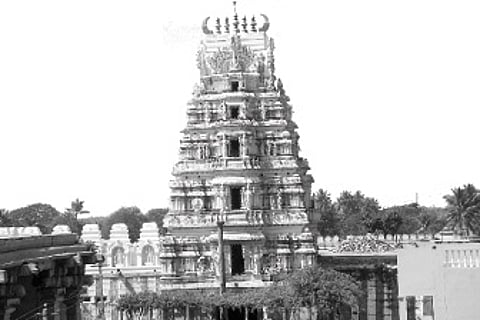

I had been hearing about the beauty of the Ambegal Krishna(crawling baby Krishna) in the Aprameya temple near Channapatna from my music teacher every time we sang the famous composition by Purandhara Dasa Aadisidale Yashoda Jagadodharana.
It is said that the beauty of the world famous Ambegal Krishna inspired the trendsetter of the Bhakthi Movement to compose it.
According to Chief Priest Radhakrishna Bhatt, the mention of Arunoraniya Mahoto Mahimana Aprameyana Aadisidale Yashoda Jagadodharana points to the fact that the great piece of lyrical muses was composed in the Lord Ramaprameya temple.
One Sunday, we set out to visit the temple in Mallur, 60 kilometres from Bangalore. Travelling along the Bangalore-Mysore Highway, we stopped at Channapatna and got the directions to Lord Aprameya Swamy Temple as it is known locally.
On the left side of the highway, about two kilometres after Channapatna, there is a big arch leading to the temple. The beauty of the temple and quadrangular Mantapa in front of it, strikes you even at the first glance. A Deepastambha with the insignia of Lord Anjaneya greets you at the entrance of the temple.
The extremely large wooden main doors to the temple has square patterns and studded with small brass discs. The splendour of the temple takes your breath away.
The temple is as ancient as 3000 years and has documentary evidence to prove that the lighting of the lamps to Lord Aprameya was done as far back as 980 AD.
There is a written document in Tamil that is preserved till date which says the temple was built and expanded by the Chola King Rajendra Simha in the 4th century.
The temple is square shaped with beautiful carvings on the towers and the pillars. The five-tier rectangular Gopuram has very beautiful sculptures of gods, goddess, animals and human forms.
Ranga mandapa, a large hall with intricately carved pillar can be seen used as a large audience pavilion around the temple Prakara. Sculptures of various antics of Krishna as a child and also Dashavathara (ten manifestations of Vishnu) are carved on the pillars.
According to the chief priest, the speciality of this temple is that it does not have any solid foundation, but has been erected directly on the sandy area. He has a very interesting story to tell about how the place got its name.
“The stepmother of King Saarangadaara, King of Mukundarajapattana, fell in love with him.
When he spurned her advances, she had his limbs torn off and dumped into River Nirmala. Inspite of his agony, it is said that he floated around in the water chanting the name of the lord.
Pleased with his devotion, Lord Aprameya granted him Jyothi Darshan, blessed him and his limbs grew back,” Bhatt said.
He continued, “Another reason is that being on the banks of River Kanwa (the then River Nirmala), the place was filled with huge amount of sand and thus, called ‘Marloor’ and shortened to ‘Mallur’. The temple has been given several names based on different puranas. It is called ‘Dakshina Ayodhya’ as Lord Rama stayed here during his exile, ‘Chatur Veda Mangala Pura’ or’Ramaprameya’ as highly educated people well versed with all the four vedas, stayed here.
It was also called ‘Rajendra Simha Nagari’ as this was the capital of the great empire of the Chola King Rajendra Simha.”
The idol of the presiding deity of the temple, Lord Ramaaprameya (the name mentioned in Vishusahasra nama and the name aprameya is also mentioned in the Shiva-Narada conversation in the 12th chapter of Brahmanda Purana), carved out of Saligrama, is in the standing position with Abhayahastha.
There is an exact replica of the idol carved in sandalwood and placed in Shukanasika Mantapa accompanied by consorts Bhoom Devi and Sridevi and Sage Ramanujacharya being used for the purpose of Utsava(processions).
Another speciality of the temple is that during the Hasta Nakshatra Mesha Masa (April Month), the sun rays fall directly on the foot of the Lord. Priest Radhakrishna Bhatt claims that this is the only shrine built for Lord Ramaaprameya in the world.
On the left side of the temple is the sanctum of Goddess Aravindavalli. The main attraction, however, is the baby Krishna in a crawling position with the right arm in raised position holding butter. The Ambegal Krishna or Navaneetha Krishna, as it is called, is made of black stone and has the innocence of a year old child on its face.
There is a Purandaradasa Mantapa in front of the Rajagopuram of the temple as a tribute to the great poet.
It is said that about 130 years ago, Maharaja of Mysore, the then King from the Wodeyar dynasty was so besotted by the beauty of the Navaneetha Krishna idol that he took it away with him to his palace.
He ignored his dream of Krishna urging him to return the idol to its original place failing which grave danger would befall him. However, the King was forced to return it when the palace caught fire and a part of it was destroyed.
It is also widely believed that childless couples who prayed to Navaneetha Krishna would be bestowed with a child. Such couples repay the lord’s debt by presenting him with toy cradle made of wood, silver or gold depending on their capacity.
We met a few such couples who had brought tiny silver cradles to offer to the lord. Hundreds of tiny cradles were seen hanging from the roof of the “Garbha Gudi” of Navaneetha Krishna.
This temple can well be called a temple consortium of South Karnataka as around this temple are four ancient shiva temples: Arakeshwar, Kailasheshwar with consort Swarnambika Devi, Varadeshwara, and Yagneshwara.
