
A drive to Hasserghatta in Bangalore is like shifting gears from frenzy to restfulness as you leave behind the clutter of urban sights and sounds to be embraced by colonies of old, sheltering trees, hamlets and simplicity. But even here, the occasional glassy eyed building exemplifies the urban growth that swallows everything in its way.
Kuteeram, the warm little ode to organic architecture is situated in Hasserghatta and wistfully reminds us of how connected we can be to the earth if we build in congruence with it and not against it. The rustic resort was designed many decades ago by architect Gerard D Cunha who interestingly in his youth, got disillusioned with the study of conventional architecture and spent a lot of time around the British-born Indian architect Laurie Baker, considered by legions of admirers as the Gandhi of architecture.
Baker wove contemporary architecture with ideas of sustainable, cost-effective, organic and energy-efficient aesthetics and extensively used local materials and his influence can be seen in the way D Cunha designed Kuteeram at the behest of danseuse Protima Bedi.
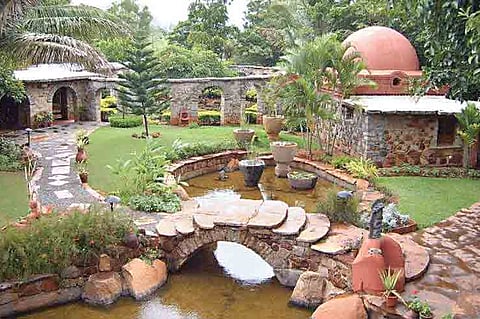
Bedi wanted to create a reclusive, earthy retreat for people exhausted by the pace of city life. Later the resort was taken over by a leading hotel chain but its uniqueness has not been interfered with. The resonating meditation dome with its dramatic acoustics is still there, as is the almost unstructured symmetry of cosy circular rooms and languid suites divided by gravel and stone pathways. The entire property has an uncultivated quality about it as tall grasses and flowers run wild, bird chatter is loud and a little bridge over a water body anchors the space.
It retains the integrity of De Cunha’s design that in an almost surreal manner flows around domes and archways, willing structures made of the earth to rise, weaving a raw granite, brick and stone tapestry of details within details. It is not unusual for visitors to spot a bunch of quarrelling geese under a bush hung with red trumpets or snails lazing around frangipani blossoms. There are also long-limbed sculptures. Lotus pads. Raw granite verandahs with built in seats.
Rooms have no wasteful wooden furniture. Instead there are built-in red oxide seats, a red oxide masonry bed and the roof, a dome fashioned out of circles of rough bricks rises breathtakingly. The roof is an architectural marvel because there are no visible beams supporting it Also in the rooms are traditional slat windows, stenciled walls and cane matted storage spaces. The bathroom with its theme of broken tile mosaic has a quaintness though it remains efficiently modern.
Like Baker, D Cunha replayed the philosophy of design that is relevant to its geography so Kuteeram is built to take maximum benefit from the easy going Bangalore weather, to welcome sunshine and even pleasant sprays of rain in the al-fresco restaurant. The materials are contextual too from stone to brick and there is a complete absence of polished granite, expensive marble, imported tiles and glass which are now used most often in resorts. Windows have stained glass panels that filter sunshine dramatically to show how imagination and out-of-the-box ideas can fill a space with colour and character.
Kuteeram has grown into a cultural landmark and the corporate branding has resulted in annual weather-proofing and maintenance and the resort has grown attuned to modern needs and offers comforts to guests looking for them.
Kuteeram encourages you to slow down, reconnect with nature, go on cycle rides, relax with a newspaper under a tree or sit on the terrace with a cup of coffee. Or just rediscover silence, sunlight without being interrupted by door bells and the noise of a city hurtling towards an invisible rainbow.
Kuteeram’s earth-bound and reflective design won D Cunha a national award.
(Reema Moudgil is the author of Perfect Eight, editor of unboxedwriters.com and an RJ)