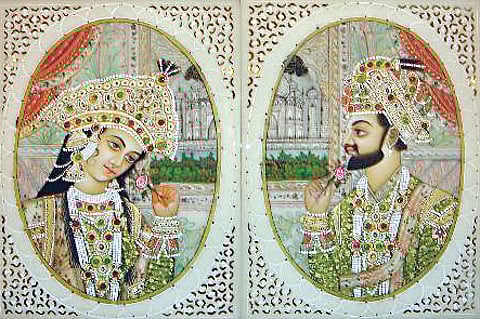

One year after Jahangir granted Khurram’s request to marry Arjumand Banu Begum, Khurram was married — but not to Arjumand. His first wife was a Persian Princess, Quandari Begum. In those days, members of the royal family could not pick their wedding days and were indeed fortunate if they could pick their wives.
The actual wedding days were set by court astrologers whereas the marriage arrangements were dependent on external political considerations, military conditions, alliances and generous dowries which were checked against the stars. Muslim law allowed every man four wives and any respectable Muslim nobleman, if he did not wish to have his virility and solvency questioned, was expected to keep concubines as well. Monogamy was impractical and unacceptable for a prince.
For five years, Khurram and Arjumand waited. They were not allowed to meet and passed this period without laying eyes on each other. Finally, in 1612, when all calculations of the astrologers were in accord, the long anticipated wedding of Khurram and Arjumand took place.
In the centre of the marriage procession rode Jahangir and Prince Khurram, surrounded by omrahs and mansabdars, officials of the state, some of them wearing robes which had taken six years to embroider. The royal family was flanked by musicians and dancers and acrobats who rolled alongside the procession as it made its way to the bride’s house and back to the palace. From the backs of elephants, ladies in howdahs peeked out at the masses from behind curtains of spun gold and members of the royal family followed the emperor in silver palanquins, tossing gold mohurs into the crowds of onlookers, who sometimes trampled one another to death in their rush to reach the coins.
All the trappings of the exotic east were present, painted pygmies carrying caged panthers and yellow parrots, long robed dervishes saying their prayer beads, eunuchs in silks, sweating coolies carrying torches or beating away the crowds that strayed too close to the regal entourage, and muscular slaves who shooed away flies with elephant ear fans and chanted songs in an unknown tongue.
The ceremony as is customary in Muslim weddings took place in the bride’s home. At midnight, a gigantic feast, attended by the emperor himself, a rare honor was given. Jahangir, whose life consisted primarily of hunting antelope, drinking large quantities of wine mixed with a tincture of opium, torturing men and romancing Nur Mahal, and who had come to consider himself as a walking encyclopaedia, judged the charm of Arjumand to be incontestable.
As a mark of the great esteem he felt for his new daughter-in-law, he bestowed on her the highest of honours, a new name. Henceforth, she was to be known as Mumtaz Mahal, 'Chosen one of the Palace'.
After the wedding, the prince was with Mumtaz day and night. She was beautiful, demure and so intelligent that she became a political advisor to her husband. She was charitable, giving food to peasants and silver to the beggars who called to her each morning outside the palace. She was compassionate, drawing up lists of helpless widows and orphans and ensuring that the prince attended to their needs. She was generous, supporting hundreds of poor families and arranging pensions for hundreds more.
Mumtaz Mahal, however, was also of Mughal blood. She also enjoyed watching the barbaric torture of prisoners as much as her husband and is said to have been the cardinal voice behind the brutal religious persecutions of the Portuguese Christians who had settled in Bengal near the site of modern Calcutta.