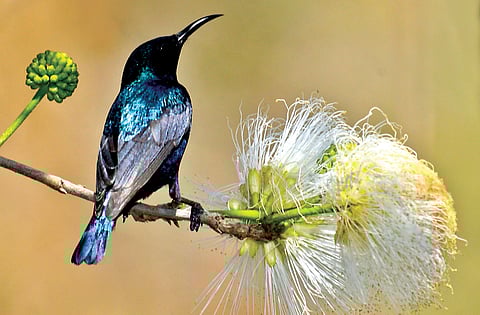

As the cold days of winter recede, the sun becomes brighter and the days warmer. Living in the hills in Dehradun, we welcomed the warm weather after an extremely cold winter. We aren’t the only ones welcoming the weather; other living creatures welcome it too. On our morning walk today a small cheerful bird greeted us. This bird, the Purple Sunbird (Cinnyris asiaticus) is glossy purple-black, with a long bill which curves down. While its wings are brownish, the rest of its feathers gleam brightly in the sunlight. To bring additional cheer to the world around it, the sunbird sits on prominent perches such as telephone wires and calls loudly to anyone who cares to listen “Chee, chee, chee, chee.” It’s a bright sunny morning and I love it, the bird seems to say!
We took four rounds while walking through the society and on each occasion, the purple sunbird was present to greet us. The one we were watching was a male. The female sunbird is not as attractive as the male bird. It is olive-brown on top and pale yellow below.
The male sunbird’s vociferous calling wasn’t really to greet us but rather, to announce its presence to the females and to warn other intruding male sunbirds.
As spring approaches, it is the breeding season for most birds, and the purple sunbird is no exception. The gleaming feathers of the male sunbird are new and fresh, in the hope of attracting a female.
The male sunbird adopts an interesting strategy. During the non-breeding season, it moults (sheds its old feathers and grows new ones) and adopts colours that are not bright and attractive.
It looks like the female sunbird — dull olive-brown — but has a black line down the middle of its belly, which the female lacks. Come the breeding season, the male sunbird needs to dress up and look as handsome as possible in order to attract the female sunbird. So it moults again and becomes a glossy purple-black; dark and handsome, it hopes!
The cheery sunbirds are mainly nectar feeders. They have long tongues that allow them to delve deep into long-necked flowers to access the nectar. Hence, they are seen frequently on flowering bushes and trees such as siris, bottlebrush, canna lily and the Indian coral tree. Many people mistake the sunbirds for hummingbirds. But there are no hummingbirds to be seen in India.
The purple sunbird is a common garden bird throughout India. As it goes about feeding on flowers, it also helps in pollination.
It’s a fair trade off; nectar for the birds, in return for pollinating the flowers it visits.
Feedback and queries are welcome at sanjay.sondhi1@gmail.com