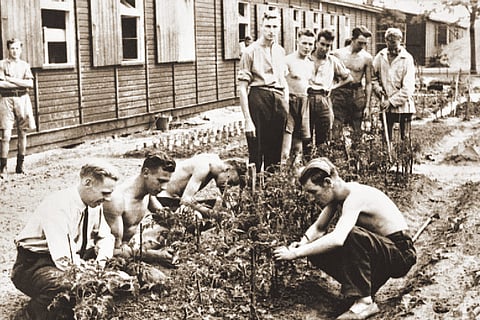

Remember the movie, The Great Escape, the Hollywood classic which chronicled the mass breakout from PoW camp Stalag Luft III on March 24-25, 1944? This daring and dangerous attempt at freedom by PoWs of the allied forces was swiftly followed by a terrible retribution — the cold-blooded murder of 50 recaptured prisoners, on Hitler’s direct orders.
On March 29, 1944, Australian squadron leader James Catanach and three fellow Allied airmen found themselves languishing in a Nazi prison just a few miles short of the Danish border. After being prisoners in Stalag Luft III, a notorious PoW camp located 100 miles south-east of Berlin, freedom seemed so close just days before.
Two years after being shot down over Norway, Catanach was part of the most daring escape of the war. Some 76 Allied airmen tunnelled their way out, before attempting to disperse across Europe and escape to Britain.
The 22-year-old Australian spoke fluent German and believed, wrongly as it transpired, that he had a reasonable chance of making it to neutral Sweden. Catanach and Arnold Christensen of the Royal New Zealand Air Force managed to make their way to the railway station at Sagan, the town nearest to the camp, and catch the express to Berlin. They spent the night in the capital, avoiding detection, and purchased train tickets to Flensburg. It was here, in this ancient city on the Baltic coast, that they were spotted and arrested.
Now, with Christensen and the other two who were Norwegians with the Royal Air Force, Catanach sat wondering what awaited them. They assumed the Germans would return them to a prison camp as was normal protocol.
But that afternoon, Major Johannes Post of the Gestapo and his comrade Oskar Schmidt arrived to question the quartet. Post was an ardent Nazi, fanatically loyal to Hitler and intimidating to all who knew him. The interrogation proving futile, the prisoners were handcuffed and marched to the waiting cars outside. Post took custody of Catanach in his car and set off with his driver, eyeing his captive in the rear-view mirror. Out in the countryside, the Mercedes came to a halt.
Schmidt and his two partners marched the other prisoners across the road. One of the airmen saw a dark object lying in the grass. The realisation that it was Catanach drew a panicked scream. All three jumped backward and tried to scramble away before three gunshots echoed across the meadow. Two of the airmen fell lifeless; the third hit the ground but struggled, opening his mouth as though wanting to speak. Post approached the airman and put a bullet in his head.
Built on Hermann Göring’s orders, Stalag Luft III was situated in a pine forest 200 miles south of Germany’s Baltic coast. The camp holding Allied airmen was designed to be escape-proof. The barracks were set on stilts. Concrete pilings that served as foundations for each washroom and kitchen were dug into the earth. Prisoners would have to dig through these before they even hit soil.
And the Germans sank microphones 10ft underground to pick up sounds of any subterranean activity.
Squadron Leader Roger Bushell arrived in1942. He had already been a prisoner for two years and had a reputation as a veteran escape artist.
Assuming command of the escape committee, Bushell hatched a plot to break out 250 inmates.
The audacious plan called for the simultaneous digging of three tunnels named Tom, Dick and Harry. To avoid the microphones, vertical shafts would be dug 30ft down before horizontal digging commenced. To reach the cover of the nearby forest, he estimated that tunnels would have to reach at least 200ft.
Wait for the next issue to learn about the great escape.