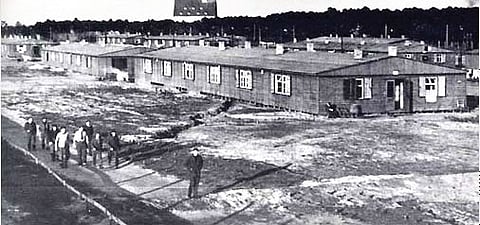

The last time you read about how the POWs hatched a plan for the simultaneous digging of three tunnels named Tom, Dick and Harry. To avoid the microphones, vertical shafts were dug 30 ft down before horizontal digging commenced. To reach the nearby forest, they estimated that tunnels would have to reach at least 200 ft. Disaster struck in September 1943 when Tom was discovered, but by March 1944 it was thought that Harry — at 336ft — had reached the cover of the trees. The escape was set for March 24, a moonless evening.
On that night, freezing temperatures had hardened the ground. It took more than an hour to open the exit shaft, only to reveal a near-catastrophe: Harry fell a good 20ft short of the forest, meaning escapees had to risk crawling across open, snow-covered ground to the trees.
By four in the morning, it was decided that the 87th man in the tunnel would be the last to go. Above ground, a sentry patrolling the perimeter approached the edge of the woods to relieve himself, only to notice steam rising from the ground. As he approached, three escapees broke cover with their arms raised high. Startled, the guard fired a single shot into the air. Armed guards swarmed the compound and eventually a roll call was taken. The numbers tallied were startling. Seventy six men had escaped.
Hitler’s rage was all-consuming. He summoned SS chief Heinrich Himmler and Göring and ordered that all 76 fugitives be executed upon recapture. Himmler proposed that 50 be executed and Hitler ordered the plan in motion.
The Kriminalpolizei (the criminal-investigations department of the Reich police) ordered the military, the Gestapo, the SS, the Home Guard and the Hitler Youth to put every effort into hunting the escapees down. Five days after the breakout, 35 escapees languished behind bars in the cramped cells of the jail at Görlitz, not far south of Sagan. Those who remained on the run were seized at checkpoints, betrayed by informants or simply thwarted by freezing temperatures.
Two weeks after the escape, just six men had been returned to Stalag Luft III and placed in solitary-confinement. Soon, officer Herbert Massey was informed by the camp commandant that 41 had been killed while resisting arrest or attempting to escape; not one had been merely wounded.
A list identifying the victims appeared on the camp’s noticeboard and contained not 41 names, but 47. A representative of the Swiss Protecting Power was given a copy of the list. The Swiss government then reported the killings to the British government, including three additional victims, bringing the total number to 50. Churchill was incensed, and even amid the final push for victory made finding the killers a priority.
In August 1945, detective-sergeant Frank McKenna was selected to mastermind the hunt for the killers. His plan was to comb the files of regional war-crimes record offices to establish leads.
In 1947, 18 defendants in the Sagan case went on trial at the British Military Court in Hamburg charged with committing war crimes by killing and ordering to kill the prisoners of war. All the defendants pleaded not guilty.
The defence argued that orders issued by Hitler were legal; disobeying them was not. But international law deemed the following of such orders to be illegal, and in 1947, all were found guilty and14 were sentenced to death.
Six months later, the 14 Sagan murderers were hanged, bringing to an end one of the most extraordinary manhunts of the 20th century.