
A tiny lead ball is thought to have triggered a rebellion that saw millions of Russians die and gave rise to the world’s first communist state. When the ball narrowly missed hitting Tsar Nicholas II after it was fired from a cannon in 1905 in St Petersburg, it is believed to have set in motion a chain of events that culminated in the Russian Revolution. The lead shot missed the Russian Tsar by three feet when it was fired during a ceremonial salute outside the Winter Palace in January 1905.
Although an investigation later found the shot had been fired by accident, Nicholas II is said to have been convinced he was the target of an assassination attempt. Three days later, the Russian Imperial Guard opened fire on a crowd of striking workers and their families during a peaceful demonstration, killing almost 100.
This incident earned the Tsar the title ‘Nicholas the Bloody’ and led to a decade of civil unrest that culminated in the Russian Revolution of 1917.
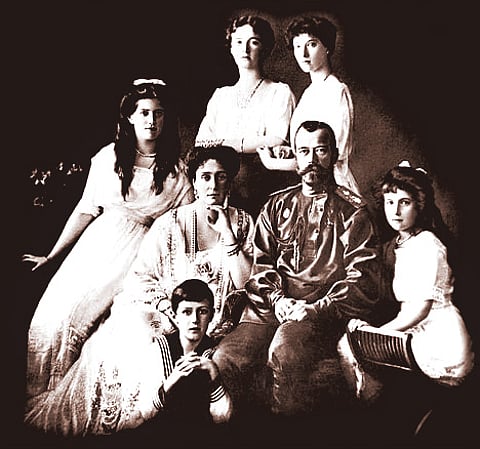
The rebellion dismantled the Tsarist autocracy in Russia and paved the way for the creation of the USSR, led by communist revolutionary Lenin. Tsar Nicholas II and his family were executed in 1918.The shot was recovered from the scene of the 1905 ‘shooting’ by a Russian duke who was standing next to the Tsar at the time. He took it to famed goldsmiths Faberge where the shot, which measured 1.5 inches in diameter, was mounted on a gold seal that was later given to Nicholas II as a present. A member of the royal court took it with him when he fled Russia at the outbreak of the revolution.
Nicholas II’s grandfather was assassinated by revolutionary terrorists in 1881, and when he became Tsar in 1894, he used severe measures to subdue resistance movements. But by 1905 he was seen as a weak leader, and on January 19 that year, he concluded that the grapeshot fired from a cannon was an attempt on his life. This grapeshot ball is said to have missed him by three feet while another shattered a window, showering the Tsar’s mother, the Dowager Empress, with splinters of glass.
Russia was a country on the brink of mass political and social unrest at the time of the so-called assassination attempt on Tsar Nicholas II. The day when soldiers of the Imperial Guard shot unarmed striking workers as they made their way to the Winter Palace in a peaceful demonstration, killing up to 100 people, came to be known as Bloody Sunday, a day that would prove to have grave consequences for the Tsarist regime. It is widely regarded as one of the key events that sparked the eventual Russian Revolution of 1917, which led to the dismantling of the country’s Tsarist autocracy
The series of rebellions saw Tsar Nicholas II forced to abdicate in February of that year, and ultimately paved the way for the creation of the USSR in 1922. In October 1917 the Bolsheviks overthrew the shaky provisional government established after the abdication, and Nicholas and his family were eventually held in a prison in Yekaterinburg.
In July 1918, as anti-Bolsheviks approached the city, the family was executed. They are believed to have been killed on the orders of the Bolshevik leader Vladimir Lenin.