
The Mughal dynasty was founded by Babur in 1525. Unlike his descendants who loved Hindustan and considered the country their own, Babur never loved India. On the contrary, he hated everything about India — its people, the climate, even the quality of fruit.
His autobiography Babur Nama provides a fascinating glimpse into the thoughts and life of the emperor. In fact, Zahiruddin Muhammed Babur was the only known founder of a dynasty who kept a journal. He started chronicling his thoughts from the time of the death of his father in 1493. At that time, Babur was only ten years old. He continued to write regularly until a year before his death in December 1530.
Except for the Tuzuk-e-Jahangiri which was penned by his great grandson Jahangir, Babur’s memoirs remained unrivalled until the publication of the diary of Queen Victoria (r. 1837 – 1901).
Babur was literate in Turkish, his mother tongue, as well as in Persian, which was the language of literature and administration. Babur Nama was penned in Turkish.
Sadly, the records of nearly 18 years are untraceable. Babur usually wrote the day’s events while they were fresh in his mind. He noted his observations about his contemporary potentates, both friendly and adversarial.
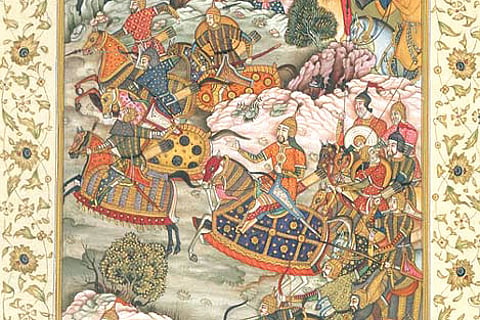
He was acutely conscious of the value of his chronicles. Despite the litany of complaints about Hindustan, he stated that he did not write to make complaints but to tell the truth. Babur’s memoirs are a rich and engaging chronicle of his domains and the administrative set up, the battles and the territories that he won and lost, the outbreak of rebellions and their suppression, the rise and fall of his adversaries and allies, his marriages and children and his banishment to a hill tract and near death.
The Babur Nama covers geography, astronomy, statecraft, military strategies and weapons, flora and fauna, social mores, poetry and painting, rowdy wine parties, tours of historical monuments and a reflection of the human condition.
Ironically, although Babur is regarded as the founder of the Mughal dynasty, he always hated the Mughals and the Uzbeks in equal measure and regarded himself as a Timuri Turk.
He is honoured in Uzbekistan where his birthplace Andijan is furnished with a Babur museum and an important thoroughfare in the capital Tashkent is named after him. Contrary to some romanticised portraits of him as a slim lithe figure, Babur was of middle size, stout and fleshy faced.
The accidental death of his father threw Babur into a cauldron of intrigue and power play. As a child prodigy, he rose to the challenge. By the time he turned 22, he had encountered more experience than most mortals do in two lifetimes. A man of piety, Babur struggled long and hard on the vexing issue of drinking wine. It was not until he was 29 that he overcame this mental hurdle, after his second conquest of Samarkand. From then on at his parties, the wine flowed like water. His journal is replete with uninhabited descriptions of such occasions when relaxed conversations blended with soothing music.
Even after he renounced wine on the eve of his battle with Rajput Rana Sangha, he remained addicted to maajun — a candy of bhang crushed with milk, sugar and spices — an intoxicant forbidden in Islam. There is much in Babur Nama which is very private and revealing, at times moving and embarrassing.
Writes Babur about his infatuation with a teenage boy called Baburi, “Until then, I had no inclination of love or desire for anyone and I composed Persian couplets, one or two at a time. This is one of them:
‘May none be as I, wretched and lovelorn;
Not beloved as you are to me, you cruel being, full of scorn....’”
Women are conspicuous in the Babur Nama by their absence although they appear in the text as wives, relatives, concubines and slaves. But they remain shadowy figures except for his maternal grandmother Aisan Daulat Begum. He consulted her in matters of state. Women are viewed more as vehicles of reproduction or slave girls as objects of sexual gratification. His journal contains numerous examples of the victor in battle killing his foe and acquiring the wife as part of the legitimate booty.
References:
Babur Nama by Emperor Babur
