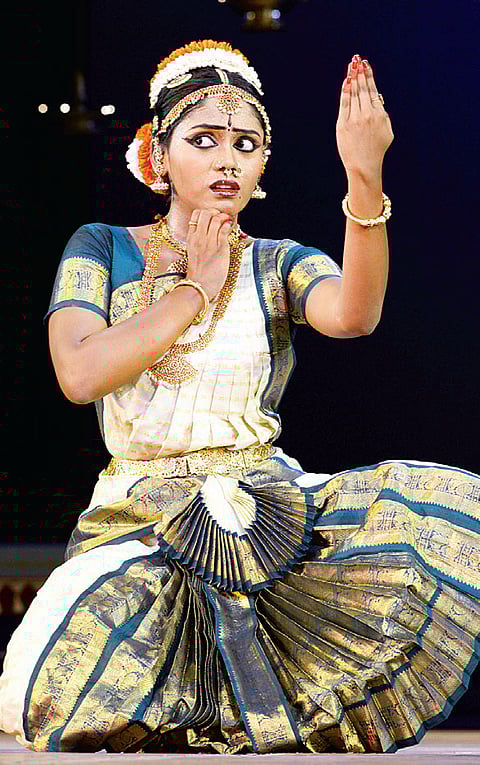

The recent rangapraveshas or arangetrams of Bharatanatyam held in Bengaluru have been proving the fact that dancers with inborn talent and potential are here in large numbers. These dance aspirants seem promising and their performances have been substantial pointers to the safe and secure future of the dance form. Some of them have become a name to reckon with. Watching just a few of their movements is enough to discover the true artiste in them. Some of the other dancers have danced the same adavus and held the same mudras as others do; but still they are not just the same. With their natural gifts and inherent talent they have been adding magnetic charm to their dance form. It is this live force that lifts their dance from the level of gymnastics to that of an awesome artistic and aesthetic experience. And of course, this quality cannot be acquired from external sources but it has to be there in the blood.
Young and very dynamic, B A Disha captured one’s attention with her neat and tidy Bharatanatyam at Ravindra Kalakshetra on Friday. Ably trained by seasoned dancer Prashanth Gopal Shastry, Disha’s dance was mature, perfectly formed and imbued with an inner quality that was impressive, creating the joy and the rasa of creativity instantly. The curtain of her performance went up with Pushpanjali. She had a Oottukaadu Venkatakavi’s krithi on Lord Ganesha Siddhi Ganapathi with a shloka and Ananda narthana to sketch and salute his attributes. The chaturashra alarippu saw the dancer revelling in a slowly increasing laya and translating the swaras and jathis into a vivid dance language. The Saraswathi jathiswara was a clean reflection of her hold over nritta.
The famous Poorvi Kalyani varna by K Dandayudhapanipillai Swamiye vara cholladi wove around a virahothkhanditha nayika and addressed to Lord Subramanya was an excellent assemblage of nritta, nrithya and abhinaya underscored by loveable artistry. The poignant sequence of the heroine pleading with her sakhi to fetch her Lord in order to save her from the pangs of separation was a touching moment indeed. Disha’s abhinaya and technique had a well-defined direction. Every movement was stylised, but ever so expressive. A fluid grace ran through the dances like a dream of beauty. The Goddess Shankari who has varied and vibrant manifestations was visualised through the dancer’s enactment on the basis of a Shyama Sastry-krithi Shankari Shankuru (Saveri). She scored well to show a devotee who imagines the arrival of Krishna.
Myriad moods & nuances
In another performance, held at the JSS Auditorium on Sunday, slender and graceful Ragini Narayan was successful in catching the myriad moods and nuances of Bharatanatyam. Her coverage of the stage was magnificent, mercurial and breathtaking. She could strike a viable concordance between her body and spirit, technique and abhinaya. One enjoyed the experience of seeing an abstract tala given a bodily form in her admirable nritta movements.
She opened with a demanding Mallari (Nata, a nagaswara item studded with rhythmic phrases) and paid obeisance to Krishna (Kasturi tilakam and Shanthakaaram). She executed the difficult adavus with effortless ease. Continuous flow of beauty of nritta was ensured by her in underlining the intricacies of khanda nadai adi tala of the alarippu.
The ragamalika varna Shambhavi Mahishasuramardini composed by mridangist Gurumurthy was based on the names of the Goddess. Strung in Gowrimanohari, Ranjini, Shankarabharana, Revathi and Bhairavi ragas, different attributes and appearances of the Devi were portrayed in her pictorial abhinaya. Ragini became a successful nati (actress). She won laurels for her natural expression of even the subtlest emotions through her face and eyes, coupled with hand gestures and body movements. Equal proficiency in nritta and nrithya accounted for her hard work and dedication. The dancer revelled in striking different poses of the Devi.
Ragini did well in interpreting a Tamil pada (Madhuvanthi) and Purandaradasa’s Chandrachooda eulogising Lord Shiva. A composition on Anjaneya (Sharanam sharanam) was an interesting selection. The final piece - a tillana Varamu raga - came through as a celebration of the joy of dancing, an eloquent conclusion!
Remembering a legend
By her radiant appearance and her melodious and sensitive singing, the one and only legendary melody queen M S Subbulakshmi brought the magic of Carnatic music to life. Her intense style displayed an innate gift of perception of its beauty and presented it with such astounding artistic expressiveness that her music flowered and flowed from her heart. What was it that set her apart? It was her ability to infuse beauty into whatever she sang, while strictly adhering to the rigours of tradition and classicism to transcend its mere grammar and technique, to invest it with poetry and bliss, giving her music a uniquely distinctive dimension as it were. Thus her music became ‘abundance’ - ‘Sampurna’, an uplifting experience. Her singing vibrated with melody, lyrical clarity suffused with artha and bhaava.
The Bharat Ratna M S Subbulakshmi was remembered on her birthday (September 16) at Seva Sadana. Seasoned singers Sangeetha Srikishan and Shubha Ramachandran paid a musical tribute by rendering some masterpiece krithis of the divine and celebrated vocalist. There are two ways of paying respect to legends - by presenting their works and by recollecting their greatness through words. But there is always a danger of missing the mark when presenting their work. But slackening precision and the same impact and impression dilutes the purpose.
The recital under review yielded mixed results. The compere Sandhya Kumar paid a glowing tribute to the music icon. Suitably supported by Chandrasekhar (violin), C Cheluvaraju (mridanga) and Srishyla (ghata) Sangeetha and Shubha sang in turns. The recital opened with Khamach daru Maathe Malayadhwaja by Muthaiah Bhagavatar in two kaalaas. Sangeetha sang Srimannarayana (Bhowli), Bhavayami Raghuramam (ragamalika), Jagadodharana, Kamavardhini (Raghuvara, with alapana, neraval and swaras), Meera bhajans and others. Shubha’s Bhaja Govindam (ragamalika), Ramanannubrovara (Harikambhoji, with alapana) and others could have been better.