
Watching creatures in the wild requires knowledge of their habits and the habitat they occupy. During one of our summer visits to Bhimashankar, we trekked down to Gupt Bhimashankar. At Gupt Bhimashankar, there is a rocky ravine surrounded by forest, which is a great spot for wildlife sightings. I knew that the Gupt Bhimashankar was one of the few places where in the warm months of April and May fresh water was still available for wild animals. In the these months, when most other fresh water sources dry up, there is always some water in small rocky puddles at this place.
The rocky terrain meant that the water did not seep through into the ground. And the thick forest cover overhead meant that the water did not evaporate quickly.
Knowing this, during one of our April visits, we parked ourselves near the water puddles to attempt to see some wildlife. Time passed slowly, as we sat quietly, enthralled by the sound of birds up in the trees, the fragrance of fresh flowers, and the heightened anticipation that we might get to see wildlife.
Soon, a small Indian mongoose (Herpestes palustris) made its way to the water’s edge to quench its thirst. It did not know it was being watched, and was quite oblivious to our presence. Some more time passed, and a shekru or the Malabar giant squirrel (Ratufa indica) called from the trees above us. Would it come down to drink water and give us an opportunity to observe it closely?
As we waited with bated breath, a pair of white-bellied blue flycatchers (Cyornis pallipes) dropped in to bathe and drink in the puddle. This flycatcher, an insect-eater, is endemic to the Western Ghats and breeds in Bhimashankar. Our wait for the shekru proved futile as it did not come down to drink. Perhaps, it could see us and was wary.
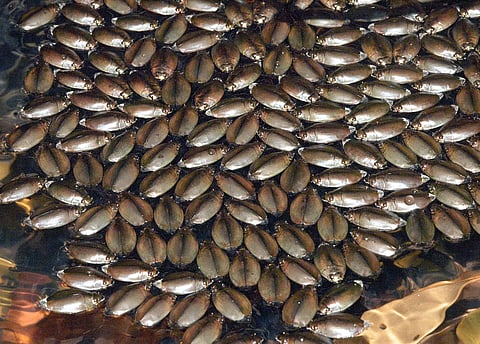
We made our way down to the puddle and sat beside it. A buzz of insect activity greeted us! Dozens of water beetles swam in the small puddle, huddled together in a large mass, covering the entire water surface. A pair of mating water skaters zipped along the water surface. A funky looking fly, with reddish-brown eyes peered at us with its compound eyes. A dragonfly, the fulvous forest skimmer (Neurothemis fulvia) perched on a dry twig and kept its eyes on us. The dragonfly looked this way and that, and with a quick aerial survey, would grab an insect.
Bhimashankar is a special place, about four hours from Pune and Mumbai alike. one can spend a lifetime in the forest observing its denizens. If you ever get a chance, make your way to this wonderful sanctuary and you will not regret your visit.
Feedback and queries are welcome at sanjay.sondhi1@gmail.com
