
They may not win any prizes in beauty contests, but sometimes a little affection is enough to miraculously turn them into handsome princes. No prizes for guessing this one. We are referring to one of the oldest inhabitants on earth — the frog.
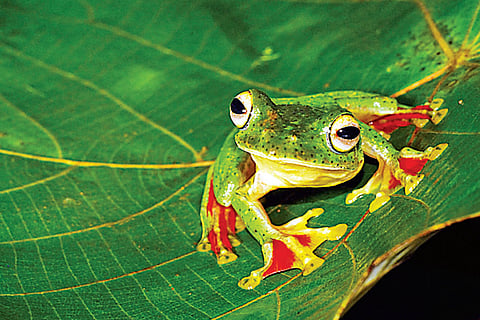
It has been the pastime of many naughty boys to catch these agile amphibians. Now, here’s one that goes beyond walking, hopping and jumping. Welcome to the world of the beautiful Malabar gliding frog.
As the name suggests, the Malabar gliding frog (Rhacophorus malabaricus) has the ability to glide or sail in the air. Rhacophoridae is a family of the frog species, which can be seen in tropical regions of Asia and Africa. They are commonly known as ‘bush frogs’ or ‘moss frogs’. Some members are arboreal and are called ‘tree frogs’ and reproduce on trees. Among the most spectacular members of this family are the ‘gliding frogs’.
The Malabar gliding frog is found in the evergreen forests of the Western Ghats. They are normally quiet and seldom glide. But when predators like a tree snake approach them, these frogs spread their limbs with their webbed feet and plummet down from the tree’s canopy, only to glide smoothly like a parachute for around 10 metres in the air. The webbing between fingers and toes is a spectacular orange-red and adds colour to this jungle show.
Our first encounter with the Malabar gliding frog was quite interesting. While it was hot in the mornings in the forests of the Western Ghats (Kukke Subramanya, Karnataka), the evenings yielded good, heavy showers. Once after it had poured, we decided to go for a drive along the forest route. Upset that we had not been able to see any bird or mammal, we joked that even if we saw a frog it would be enough. We continued to drive on the road with dark wooded forests on both sides and it was pitch dark save for the headlights of our vehicle. As the vehicle attempted to make a U turn, what do the headlights of the car show us but a beauty of an amphibian — the Malabar gliding frog with its vivid green colour hanging on a twig, with its protruding eyes and spectacular orange-red limbs folded underneath it. He sat silent as if enjoying the attention that was being given to him.
We generally spot them in hedges, coffee plants and trees but rarely on the ground. These acrobatic frogs are active in these forests only during the monsoon.
Normally, these gliding frogs become active in the night and stay motionless in the daytime.
Their large eyes help them locate their prey at night. Frogs have
wide mouths and sticky tongues, which helps them catch their prey and moisten the food before swallowing.
The life cycle of a Malabar gliding frog is indeed fascinating and worth knowing.
Many breeding frog species congregate on tree branches near rain pools. Each species calls out to the female, through a series of clicks produced from its vocal sacs. The female listens to the loud calls made by its own kind and arrives at the spawning site.
Tree frogs mate on trees and they tend to employ the external fertilisation method.
The female builds a foam nest about a metre above small rain pools or a stream. A male frog which is smaller than the female grasps the female with his front legs and beats its legs to form foam. The male frog sheds seminal fluid into the foam as the female lays the eggs. This behaviour is known as amplexus.
The foam hardens and acts as a protective casing for the eggs. Unlike reptile eggs, frog eggs do not have a shell, but are enclosed in a gelatinous envelope.
The female gliding frog lays up to 200 eggs in a clutch. After five days the eggs hatch and the tadpoles within the foam nest drop down into the water along with the rain water. The female gliding frog lays only one clutch of eggs per year.
Amphibians are indicators of a healthy eco system and in recent decades there has been a dramatic and large scale decline in the amphibian population for many species around the globe.
Disease, the use of pesticides, pollution, climate change and habitat destruction are the main reasons behind the decline of these beautiful forest creatures.