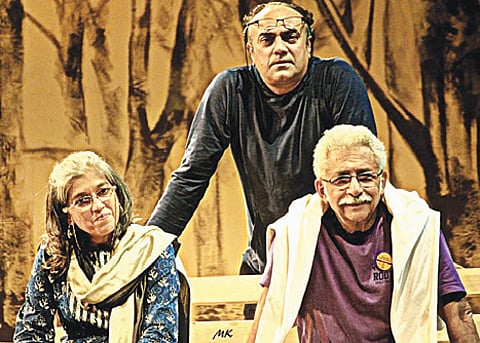

BANGALORE: Theatre, film and small screen actor, Ratna Pathak Shah, is coming to the city this weekend for two plays by Motley.
While she has directed her husband Naseeruddin Shah and Rajit Kapoor in A Walk in the Woods, which will be staged on Friday evening at Chowdiah Memorial Hall, she will perform in Ismat Aapa Ke Naam, a play with three stories drawn from Urdu writer Ismat Chugtai's expanse of work — Chhui Muee (told by Heeba Shah), Mughal Bachcha (told by Ratna Pathak Shah) and Gharwali (told by Naseeruddin Shah).
In an interview, she
talks of how Ismat Aapa... began, with its first performance in Bangalore, her memories of the city and the relevance of the Urdu writer's work in today's context.
Excerpts:
Could you tell us how Ismat Aapa Ke Naam started out and how many of Ismat Chugtai's stories you've performed so far?
In 2001, we started working on three stories by Ismat Chughtai and we have done about 300 shows in the last 14 years.
I feel blessed because I was introduced to wonderful writing in an Indian language. We had been looking for original material and this has been a great discovery. Her work is a treasure trove of sharp, smart and modern writing, though
she was writing nearly 50 years ago.
Her understanding of human beings, their loves and frailties; her extraordinary ear for different dialects and ways of expressing oneself; her truly modern and humanistic view of the world, all combine to make her one of the finest writers the sub-continent has produced. Reading her stories today, it is difficult to believe that she is not my contemporary.
I also feel blessed because I have had the chance to live with a play for so long -- the learning is immense and the pleasure, incomparable. We have now done eight of her stories and are planning three more.
Will you have to switch characters while you’re performing Mughal Baccha?
We tell the story without trying to dramatise or enact it. It is like listening to your grandmother/ mother/ aunt/ uncle -- the family storyteller -- who becomes all the characters while narrating a story. So yes, there is switching between various voices.
It has been quite a challenge but also a great discovery because it is very satisfying when you begin to imagine all the characters and find voices/behaviours for all of them, while not ‘becoming’ any of them.
How relevant do you think the gender questions raised by Ismat Aapa are today?
Sadly more relevant today than ever before. The more things change, the more they remain the same. In fact they seem to regress.
I don’t think there is any woman like Lajjo (the character from Naseer’s story Gharwali) that I have seen around me today, though we have been ‘liberated’ for several decades now.
Tell us a little bit about your memories of Bangalore and what you feel about theatre scene in the city...
I have many wonderful memories of Bangalore, since my childhood. My Dad used to drive us down often from Mumbai (Bombay then). It was always, green, cool, clean and full of interesting characters. I love performing in Bangalore. It has the most theatre-literate audience in the country. In fact, the first time Ismat was done here, I was surprised by the audience reaction as I had expected that they would have trouble with Urdu. We’ve performed here many times since and look forward to it each time.
Bangalore is one of the few cities that regularly invites us to perform -- New Delhi and Kolkata have not called us in years!
How does playing Dina Pathak’s role in Khubsurat feel?
It’s fun. It’s quite a different film from that one. I’m looking forward to seeing it as I enjoyed making it.
You haven’t done any other television shows after Sarabhai Vs Sarabhai. Will we see you on the small screen anytime soon?
Not unless I find something that I can do. I find it impossible to watch most of the things. I feel we really blew our chance with television. It was a medium of great potential for a country like ours, where we can hear a story that stretches forever. Look at Mahabharat! But I hope things will change for the better. They can’t get any worse!