
After throwing off the shackles of a decadent monarchy, France became a republic in 1792 following the Declaration of the Rights of Man and the Citizen in 1789. The French Republic was formed by an idea conceived by the people and for the people. The essence of the French Republic is that it is ‘one and indivisible’, meaning it is made up of equal citizens, not separate communities. Therefore it is inconceivable that a country like France, whose very foundation was built on such noble precepts, could institute a penal colony that became synonymous with brutality.
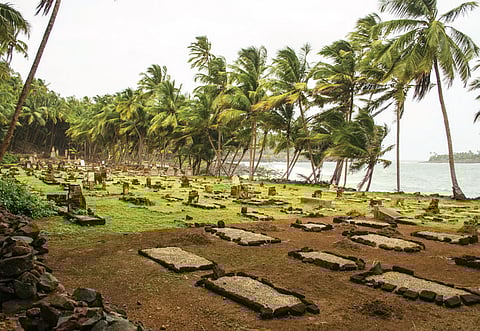
Devil’s Island in French Guiana was once one of the most feared prison colonies in the world, where France incarcerated convicted criminals — many of whom were innocent. Devil’s Island was a place where no Frenchman would go unless sent by a judge. In this island and in prisons on the mainland, 60,000 prisoners endured a living death dubbed the ‘Dry Guillotine’. It has been more than 50 years since France abolished this abhorrent practice and the last shackled prisoner returned home. Today, this beautiful, lush island has become a macabre tourist attraction.

Ghosts of the condemned men are everywhere — in the crumbling ruins, at the wooden jetty that once echoed with the sound of shackled feet, clad in shapeless red and white striped pyjama pants, hollow-eyed and gaunt men who were just shadows of their former selves after having given up the last glimmer of hope for freedom or escape.
The penal colony came into existence in 1852 when Louis Napoleon III, the President of France, sent convicts to the colony to do the work once done by African slaves until it was shut down in 1946. The entire dehumanising process began as each consignment of convicts made the long 15-day trip from Marseilles to the mainland prison at St Laurent located on the northern tip of South America, crammed like sardines in steel cages below decks, 80 in each cage, where tempers inevitably flared as men fought for space and food. Any attempt at rebellion was met with jets of scalding steam directed through the bars from overhead pipes. Towards the end of World War I, a converted German freighter, La Martiniere, was pressed into service to transport this cargo of human misery — unfortunate men whom French society discarded — to the settlements twice a year.
Even more shocking was the fact that most of those on board the freighter were replacements for those that had died of beatings, malnutrition and self-inflicted wounds. Trying to escape was a risky proposition because one had to contend with three merciless guardians, a jungle that teemed with an army of flesh eating army ants and alligators, a sea infested with sharks and rivers with piranhas.
Only a handful of men managed. One of the most famous was Henri Charrire nicknamed Papillon, so called for the butterfly tattoo on his chest, who escaped and was caught several times. The famous movie Papillon starring Steve McQueen and Dustin Hoffman was based on him.
Once encamped on Royale Island, the prisoners were forced into back-breaking toil. Naked but for shoes and a straw hat, up to their waists in water, each convict was forced to cut a stire (one cubic metre) of hard wood every day and receive nothing but a lump of dry bread. If the timber camps were overcrowded, the alternative was to toil on the infamous ‘Route Zero’, a sadistically futile road-building exercise. In over 40 years of hard labour, Route Zero never crossed 25 km in length.
For those convicts who repeatedly broke rules or were driven to the verge of insanity, the ultimate sanction was a living death on the nearby isle of Saint Joseph, known to the convicts as mangeuse d’homme, meaning ‘devourer of men’. Thrown into this jungle hellhole, sadistically designed to break the body and spirit, men went mad after years spent in solitary confinement known as the ‘reclusion disciplinaire’ — left in total darkness, forbidden to speak even to the guards who pushed food through the flap in the heavy iron doors. Others were bricked up in the individual dungeons, cramped cylinders of stone lit only by a three-inch hole high in the wall or kept in concrete pits with iron bars above their heads. One can still discern on the decaying walls, barely readable, pathetic prayers to a god who didn’t hear or as another simply declares, ‘A Woman Put Me Here’.