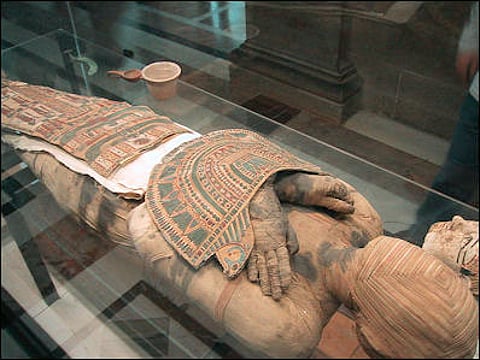

We almost always tend to associate mummies with ancient Egypt and Hollywood movies have reinforced these perceptions but the fact is that archaeologists and explorers have discovered preserved human remains all over the world.
It is believed that the word ‘mummy’ originated from the Persian word mummiya meaning bitumen, owing to the blackened state of ancient Egyptian bodies. Today this term is used to describe all human remains which have retained their soft tissue, either by natural means or artificial preservation.
The first mummy studies commenced in the early 19th century and mummy souvenirs brought back from the travels of wealthy tourists were subjected to detailed examination. Bizarre and shocking as it may seem now, at that time ‘mummy unwrapping parties’ were all a rage and the otherwise sanctimonious Victorians felt no qualms about desecrating pre-Christian bodies and even sent specially-printed invitation cards. For instance: ‘Lord Londesborough at Home: A Mummy from Thebes to be unrolled at half-past Two’.
Even more shocking was how some mummies were exported to the US for use in the papermaking industry or even to be burnt as railroad fuel.
The legend of the mummies continues to be a source of eerie fascination and mystery. Yet the fact is that these amazing ‘artefacts’ were once living people and preserving them in as lifelike a manner possible was considered a means of providing a permanent home for the soul and a way of cheating death itself.
In Egypt the process of mummification was akin to a successful industry with different levels of service being provided depending on the costs involved.
The deluxe version involved the brain being extracted down the nose and the entrails removed before the hollow body was dried out with salts. The dried skin was then treated with complex blends of oils and resins which are now a subject of intense studies using the latest analytical techniques. Hairdressers and beauticians were called in to restore and groom and make it lifelike and then the finished body was wrapped in many metres of linen. Consider this: one estate manager called Wah (c.2000 BC) was discovered wrapped in an incredible 375 square metres of material. The cloth used for wrapping could often be recycled household linen or it could be custom made for mummification.
Once the embalming process was complete, the mummies were covered in a range of protective amulets and placed in their coffins following which elaborate funeral ceremonies were held to reactivate the soul within the mummy accompanied by the words ‘You will live again for ever. Behold, you are young again for ever’. Finally, the mummy was buried with generous amounts of food, drink and whatever the soul of the deceased could possibly require for a comfortable afterlife.
Egyptians usually buried their dead in the great expanses of the desert far away from the cultivation on the banks of the River Nile. While the dead from wealthy families and royalty were artificially mummified and interred in specially built tombs, the majority were simply buried in hollows in the sand.
The arid environs of the desert led to the bodies being mummified by natural means, as corrosive body fluids drained away into the same hot dry sand which desiccated and preserved their skin, hair and nails.
At times family members could end up accidentally uncovering such bodies after years. Imagine their emotions upon recognising loved ones who had died years back; it would almost be akin to witnessing eternal life in action.
Before the Egyptians had mastered the process of mummification, as the burial practices for the wealthy became more elaborate, those accustomed to burying their dead in a hole in the ground also began to demand tombs as befitting their status. But when the bodies were simply interred in caskets and buried, they rapidly decomposed since they were no longer in contact with dry sand. This demand precipitated the process of experimental mummification, and through a great deal of trial and error, the Egyptians finally cracked the problem by removing the internal organs where the putrefaction actually begins.
For the next three millennia the ancient Egyptians refined and perfected the techniques of embalming both humans and animals and became the finest practitioners of mummification that the world has ever seen.
Reference
The Scientific Study of Mummies by Arthur C Aufderheide