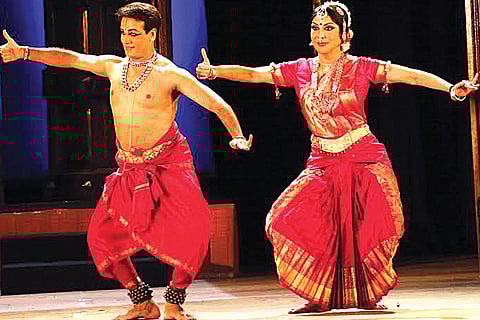

BANGALORE: An engrossing dance-drama woven around dwaaras (doors) was presented last Friday at Chowdiah Memorial Hall. Its effects ranged from a serene inwardness to astonishing theatrical virtuosity.
An abstract theme— doors — was solidified by the gifted dancer-duo Vani Ganapathi and Sathyanarayana Raju and their musicians. The show, supported by Puravankara, opened doors of creativity and artistry.
Vani and Sathya received a standing ovation at the end. They moved together with absolute unanimity and this was reflected in their coverage of the vast stage. All the elements of dance-drama including the voice-overs (by Kathak dancer Murali Mohan) were properly nourished.
Three doors served as meaningful props. Dance activist R K Usha, who did the impressive compering, also used a small door. There was great wisdom and no self-indulgence, with the same phrase coloured differently each time. I found the performance inventive, engaging, moving and beautiful.
Vani and Sathya showed a magnificent ability to maintain the tradition and classicism of Bharatanatya. To a required extent, there were some martial arts also. Almost all types of compositions explored in Bharatanatya — shloka, pada, ashtapadi, javali, tillana — were represented.
The beauty of Carnatic music was charming. To add to all this, their dancing was powerful, passionate and precise.
Sathya’s renditions were characterised by beauty of movement, style, form and execution, suggesting taste, ease and wealth of artistry. Vani’s amazing fluency in the nritta was good to behold. Her abhinaya had an extraordinary sparkle and exuded her characteristic intensity.
The dynamic rhythms of the mridanga (Lingaraju) danced with the khanjari, morsing (Prasannakumar), flute (Maheshswamy) and violin (Mysore Dayakar) and also made the dancers give out their best. A soft yet useful veena (Shubha Santosh) was enriching. But it was seasoned singer D S Srivatsa who shone forth throughout the presentation, along with the dancers. Ragas like Amrithavarshini, Bahudari, Kaanada, Mohana, Athana, and Behag, to mention a few, were appropriately adapted and sung by him.
The show dealt with five dwaras: raja dwaara (palace door), veera dwaara, (fortress door), gruha dwaara (house door), deva dwaara (divine door) and atma dwaara, (door of the soul).
These doors were defined in an introductory spell with nritta. The show opened with raja dwaara, to depict the tale of the Mahabharata. Vani and Sathya enacted the game of dice, Pandavas' defeat, Shakuni’s cunning, and Draupadi taking a oath to oil her hair with the blood of Duryodhana.
In the veera dwaara part, the bravery and accomplishments of Karnataka’s own king Kanthirava Narasaraja Wodeyar I, popularly called Ranadheera Kanteerava, were highlighted. This king created the insignia ganda bherunda (two-headed bird) and minted gold coins. Sathya stole the show with his energetic dance, martial arts and abhinaya.
The gruha dwaara segment portrayed a quarrel between an angry nayika upset with her nayaka’s insincere love. They finally come together to rejoice, with a tillana rendering. For this, the Behag javali (Endendu vachchitivira) and an ashtapadi (Charusheele, twamasi mama bhooshanam) provided lyrical inputs.
The interaction between Vani and Sathya as the hero and heroine was scintillating. The sequence of nayaka Krishna (Sathya) trying to pacify his nayaki (Vani) left an indelible mark on the minds of the viewers.
The fourth segment, deva dwaara, underscored the supremacy of devotion to the Lord. For this, the story of Andal was enacted. Vani was at her best as Andal. No talk about doors is complete without the popular Kanakadasa pada Baagilanu teredu (raga Hindola). Sathya became Kanakadasa for whose sake an idol of Krishna turns 360 degrees to give darshana. He also portrayed the episodes of Gajendra Moksha and Narasimhaavatara.
The finale was atma dwaara. This was all about man’s final realisation of truth by vanquishing the six internal enemies: kaama (lust), krodha (anger), lobha (greed), moha (temptation), mada (pride) and matsara (jealousy) to achieve moksha (salvation).
For this, a Hindi bhajan Maily chaadar odh ke and Adi Jagadguru Shankaracharya’s stotra Bhaja Govindam were meaningfully interpreted. The live music support wonderfully embellished the dance drama. The choreography was rewarding and radiant throughout.
Tremendous debut
The Bharatanatya recital by young girl Nikita Subramani at MLR Convention Hall on Sunday was of a high class. One could not believe she was making her debut. Profundity and perfection marked her presentation.
Her guru Mamatha Karanth deserves to be commended for the creativity and artistry with which she has trained Nikita. Mamatha also sprang a surprise by not strictly adhering to the Margam repertoire. She did a praiseworthy job of packing all the challenging ingredients of Bharatanatya into her somewhat deviant selection of items.
Nikita Subramani was at her best in executing all the ideas of her guru. Indeed, it was her incredibly fluid dancing that grabbed my attention. Regarding Nikita’s virtuoso strain, this performance proved her credentials. This was a tremendous show, shifting between varying moods and tempos with ease.
From her first simple steps and jumps, she was breathtakingly buoyant with the softest yet scintillating teermanas. Through the conveyance of graceful and brisk movements and the orchestra’s melodious music, again led by D S Srivatsa, emphasis was placed on the storytelling, spirituality, aesthetics, artistry and technicalities of the dance.
The opening Pushpanjali was spiced with a lively nritta. The Shiva stuti Shambho in trishra aditala captured Lord Shiva’s qualities of compassion and mighty strength. Nikita’s nritta had attractive madhyamakala solkattus and swaras at Kapali dayanidhi.
One was moved to see and hear Purandaradasa’s rare gem Poochi bandide Ranga (raga Shuddha Saranga) which had interesting philosophical connotations involving the atma and paramatma. The mother tells the child Krishna to sleep or Brahma, Shiva and Hanuman will come in the form of devils and take Him away.
Swati Tirunal’s ragamalika kriti Bhavayami Raghuramam provided ample opportunities to the dancer to delineate it in the form of a varna. Each of the chittaiswaras was transformed into a refined nritta. Besides this, a chunk of nritta at different intervals was also delightful.
She displayed intricate footwork and concluded each segment by striking graceful poses. A few episodes from the birth of Sri Rama to the abduction of Sita were portrayed in an appealing abhinaya. The enactment of Manthara in particular deserves special mention. The rendition ended with a shloka.
The Kali Tandava and the depiction of the tale of the demon Raktha Beejaasura was vibrant with Nikita’s energetic abhinaya. The Tamil pada Vishamakara Kannan provided the base for her enactment of child Krishna’s several mischievous deeds, like stealing butter and teasing the gopis. The concluding Kadanakutoohala tillana brought out the dancer’s hold over rangaakramana, layakari and korruppus.
From start to finish, Nikita remained animated in her expression, delivering a riveting performance. Her controlled movements and hand gestures and the way she directed her eyes showed her diligence and profound passion for dance.
Mamatha Karanth’s nattuvanga and choreography was inspiring and captivating. Maheshswamy (flute), Suma Rani (sitar), Prasannakumar (morsing) and Narayanaswamy (mridanga) were in their element.