
A few weeks ago, I was part of a training programme for children in northeast India. One of our workshops was on snakes. The topic of snakes elicits great response from adults and children alike. These much-maligned creatures are a source of concern and fear for many. An unfortunate common response across India to the question “What do you do when you see a snake?” is “We kill it!”
India is home to just under 300 species of snakes of which approximately 60 are venomous. Many of these 60 species live in forests and will not be seen in urban or rural India. The four common venomous snakes that can be seen in peninsular India are the spectacled cobra, russell’s viper, saw-scaled viper and the common krait. The most important thing to understand is that snakes are not out to harm us. The natural tendency of a snake that encounters a human is to flee. Snakes don’t attack humans unless threatened. Their venom is not meant to kill us — it’s for their own defence against predators and to hunt their prey.

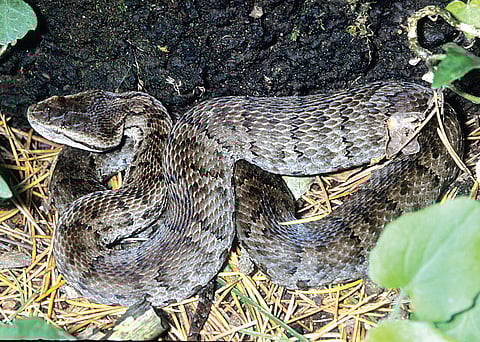
How little understanding we have of snakes and their venom is best illustrated by an incident that happened to my wife, Anchal, and me many years ago. We were walking in the conifer forests of Dalhousie in Himachal Pradesh when I came across a Himalayan pit viper peacefully coiled next to a rock on a bed of pine needles. The snake is nocturnal so was not active during the day. For about thirty minutes, I spent time photographing the snake, sometimes getting really close it. Those were the days before digital photography and as I was using expensive slide film, I had to be sure to get the angles just right. I was using an external flash and I got Anchal to hold it for me. On many occasions, I was very, very close to the snake, but as I was not threatening it, I was confident that the snake would not bite. Anchal, who is scared of snakes, was not so confident.
After we finished photographing the snake, Anchal and I had a massive scrap, with my wife accusing me of being reckless! Despite my telling her that the snake would not bite unless I harmed it, she thought I had gotten too close. The rest of the day’s walk was not pleasant. However, the argument ended when I showed Anchal the snake book, which mentioned that though the Himalayan pit viper was venomous, its bite was not fatal to man. This, in fact, is true for bites from many venomous snakes. Also, many snake bites can be ‘dry bites’, when no venom is released. In addition, the quantity of venom injected is sometimes quite small and will not lead to fatalities.
Don’t read this piece and believe that you can handle a snake! Snake handling is best left to experts. It is best to spare the snake, not bother it and allow it to slither away.
Feedback and queries are welcome at sanjay.sondhi1@gmail.com
Go green
Snakes, like all creatures, are a crucial part of the web of life in nature. In fact, snakes help humans by keeping the rodent population under control. Rodents would otherwise eat our food grains. What can you do? Well, don’t be scared of snakes, get familiar with common venomous snakes, spare all snakes that you see and convince your friends to do so too!