
Last weekend we went on a nature walk in a forest in Mussoorie. As we strode through the forest we saw a lot of interesting insect life. I kept my eyes open for butterflies and moths, and we spotted quite a few of them. On one occasion, I spotted a sailer butterfly flitting by. As there are more than 30 different types of sailer butterflies in India, I decided to sneak up on the butterfly to observe it more closely. If I see a butterfly’s upper and undersides, I can identify it to the species level.
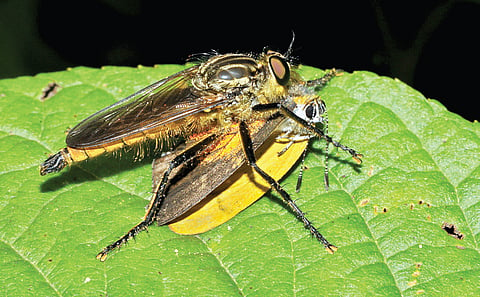
The butterfly settled on the upper surface of a leaf to bask in the sun, and I had my ‘Aha!’ moment. Now I can get a good look at its underside, I thought. As I crept closer to the butterfly, a tiny insect zipped past me, and before I could figure out what was happening, a robber fly grabbed the sailer butterfly and alas, it met a swift death. The speed at which the predatory fly caught the butterfly left me stunned! “Thief!” I muttered to the robber fly. “You could have at least allowed me to identify the butterfly. And there are so many other butterflies to be had — why do you have to grab the one I am looking at?” Well, I obviously got no reply from the thieving fly, as it was busy injecting its saliva into the butterfly. The robber fly’s saliva not only paralyses its prey, but also serves to dissolves it prey so that the robber fly can digest the fluids from its prey.

I have no issues with the robber fly catching and feeding on butterflies. After all, it’s part of the predatory fly’s diet, but over the past few months, this is the fourth occasion that a robber fly has grabbed a butterfly that I have been looking at! These insects have been trying very hard to keep their thieving habits finely honed!
I enjoy observing nature at work. And robber flies are no exception. Robber flies, master assassins and hunters, belong to the order Diptera, to which all other true flies belong, including the ones we see in and around our home. However, unlike the flies we see in our homes, which are not carnivorous and do not feed on liquids, robber flies are predatory in nature. They sit on the upper surface of leaves and from their elevated perch, wait for an appropriate victim to show up. They catch their prey in flight and are game to eat butterflies, moths, bees, ants, beetles and other smaller prey. Often, after killing their prey, they fly away to a safe spot, holding their prey between their forelegs. If they catch it, they have to eat it! If they just spared the butterflies I look at, I would be pleased!
Feedback and queries are welcome at sanjay.sondhi1@gmail.com