
What was day to day life like for the Mughals? What did they eat? How did they spend their days? How did they keep themselves entertained? We try and visualise this bygone era from the memoirs of official royal chroniclers as well as unofficial accounts of travellers and courtiers.
The Mughals may have been the descendants of Central Asian nomads, but the primary cultural influence on their court came from Persia. Thus the attire, cuisine, manners, décor at the Persian court in Isfahan was considered the last word in sophistication and refinement. Such was the hold that Persia had on Mughal culture that Persian even became the language of Mughal administration and law courts and remained so till the 19th century.

However, Persian culture was not embraced in its entirety but was infused with local elements to create a new culture and cuisine. The wives and concubines of the emperors may have played an important role in transmitting these local influences. This cosmopolitan element of Mughal culture was apparent in their Mughlai cuisine which today is one of the most popular cuisines and is served in upscale Indian restaurants around the world.
Thanks to meticulous records left behind by Akbar’s prime minister, Abul Fazal, and European travellers, we have a complete picture of what food was eaten by Mughal emperors and their courts.
Food was accorded enormous importance and the royal kitchen was a department of the state which reported directly to the prime minister. The enormous staff included a head cook, treasurer, store keeper, clerk, tasters and more than four hundred cooks, who came from Persia and various parts of India. It was mandatory that all cooks be men and of good character.
The cooking ingredients had to be of the finest quality and were sourced from every part of the empire: special varieties of rice from different regions, butter from a certain town, ducks and fowl from Kashmir. The birds and animals were fattened and slaughtered outside the city and special breeds of chicken were raised specifically for banquets or particular dishes. The palace chickens were hand fed with pellets flavoured with saffron and rosewater and massaged daily with musk oil and sandalwood. Only when deemed plump and fragrant enough they were considered ready for the emperor’s table.
Beef was rarely eaten in deference to the many Hindu officials at court and pork was forbidden for the Muslims, although wild boar was eaten. A kitchen garden ensured a continuous supply of fresh vegetables. The Mughals are remembered as connoisseurs and lovers of fruit. Akbar considered fruit one of the greatest gifts of the creator and brought horticulturists from Central Asia and Iran to supervise his orchards. Before being presented to the emperor, the fruit was marked according to quality.
Surprisingly, despite the finest delicacies at his disposal Akbar led an austere existence, eating once in 24 hours and frequently fasting. He cared little for meat and one of his favourite dishes was khichri, made from lentils and rice. As he grew older, he increased the number of days he fasted.
However, this austerity was not practised by the rest of his court. The kitchen staff had to be on constant alert as there was no fixed time for eating. They were capable of producing a hundred dishes within an hour. Served in vessels made of gold, silver, earthenware and stoneware and tied up in cloth the dishes were inspected by the head cook and tasted several times as a precaution against poisoning before serving.
Incredibly, ice was brought everyday from the Himalayas by an elaborate system of couriers for making cooling drinks and frozen desserts.
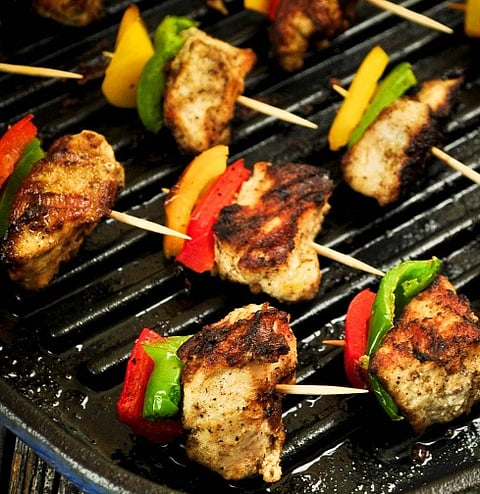
Water was dripped through saltpetre to cool it. A popular way of cooking meat was to roast it on skewers over fire or in an oven. This dish was known as kabobs which means 'without water' in Persian and probably originated from the Mongol and Turkic nomadic ancestors of the Mughals since it was easy to make over a campfire. Many ingredients such as almonds, pistachio, raisins, dried fruit and thinly beaten gold and silver leaves for decoration trace their origins to the Persian court. But while Persian dishes were subtly flavoured with tarragon, parsley, mint, dill, marjoram, the Indian cuisine became bolder with cumin, black and long pepper, cinnamon, cardamom seeds, chilies, ginger and lots of garlic and onion.