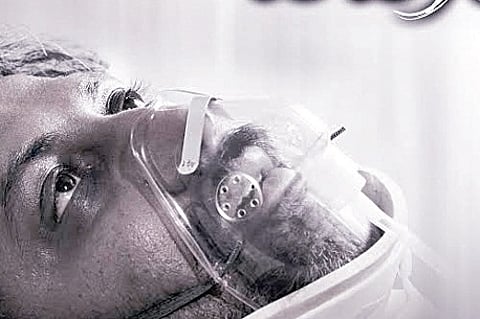

QUEEN'S ROAD:P Seshadri, whose film on euthanasia, Vidaaya, has recently made it to the Melbourne and Fiji film festivals, feels deeply about mercy killing: that’s what he had wanted for his ailing father 12 years ago.
His father suffered from Parkinson’s disease, Seshadri told City Express. “He was a retired school master and was 70 years old when he was diagnosed.”

His mother was nearly the same age, and they lived by themselves in Dandina Shivara, about 150 km from Bengaluru. “When I went to see him once and served him for a few days, I felt he needed mercy killing and even proposed the idea at home,” he says.
It was met with resistance, and his sister, a medical professional, offered to take care of him if her three brothers found it too difficult. “My mother still doesn’t know that I suggested mercy killing,” the filmmaker says. “And even now, I live with guilt, and wonder if I was right or wrong. But at that time, when I held him close, I wanted him to die in peace.”
The intent behind Vidaaya is to get people thinking about the subject, he says. While Pinki Virani’s battle for mercy killing for Aruna Shanbaug increased public awareness about ‘death with dignity’, 70-year-old Karibasamma, a former high school teacher’s plea was rejected a couple of years ago by the Karnataka High Court.
“She has many health complications and lives in a senior citizens’ home. She says there is no one to care for her or bear the medical expenditure,” Seshadri says. “She protested at Freedom Park two weeks ago.”
That the Supreme Court has permitted passive euthanasia — where life-support is withdrawn and a person is allowed to die — is a good sign, he feels. “Doctors tell the patient’s family that he or she won’t live for long, and life-support is withdrawn. It’s unofficial, but it happens often.”
He also talks of people he has known from within the film fraternity ‘who used to pop pills as though they were chocolates’. “They stopped taking the medicines one fine day, and they died,” he says.
Gandhiji supported mercy killing too, he holds. “He asked a doctor to end the pain of a calf that had met with an accident. And he had said, if I’m in the same situation, please grant me the same death.”
About the case of Aruna Shanbaug, he says, “Her mother had taken her horoscope to an astrologer and she was told that her daughter would be famous one day,” Seshadri says.
Traditional customs exist as well. “I heard that in a village near Madurai, they follow a custom called Talaikoondal. Poor people who seek death are given a castor oil bath after sunset and made to drink only tender coconut water.” This induces high fever and death.
He wonders if feeding a person on the death bed tulsi water is a similar custom. “I’ve heard a doctor say they could choke on it since they are lying down,” he says. Every person going through severe pain wants to die in peace, he believes. So, through his film, he hopes to rekindle the debate, and see a legal change.