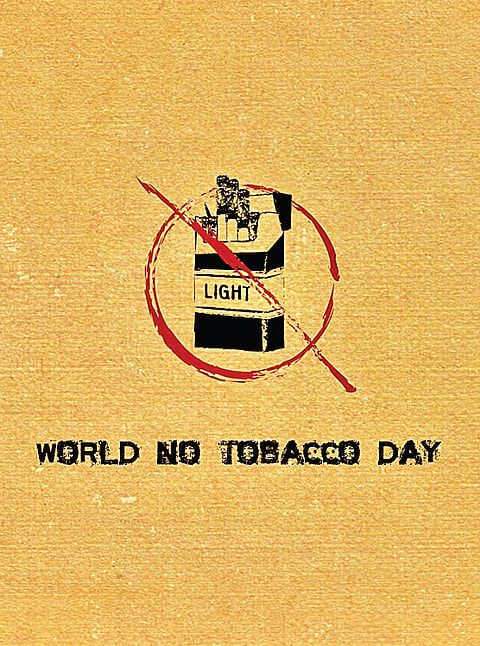

Smoking is injurious to health is the tiny message on the cigarette pack, which is seldom seen much less read. Smoking is a habit that is most harmful, life-threatening and is a living death. There are millions who are addicts and they know that they are but cannot give up this most pernicious habit. King James of England commented on smoking as being “a custom loathsome to the eye, hateful to the nose, harmful to the brain, and dangerous to the lungs”.

India is third largest producer of tobacco and tobacco products. Historically tobacco has always been used in one form or other. No wonder it has taken deep root in society and the smoke has literally engulfed many families, pushing them to abysmal depths of ruin. A most disturbing trend is adolescents taking to smoking at a very young age.
The World Health Organisation has reported that about hundred thousand children take to smoking every day and the number is only increasing. Further, about half of them will continue to smoke after they reach adulthood and most of them will die prematurely due to tobacco induced multiple diseases. Another startling statistic is that 25 crore present day children who have taken to smoking will die due to such diseases.
Use of tobacco is not just through cigarettes and beedis. Hookah is one form. In fact certain upscale coffee joints in cities offer hookah facility to attract youth. There are other smoking devices like hookli, chhutta, dhumti or chillum. Dhumti is made by rolling tobacco and the burnt end is kept inside the mouth and smoke is drawn in. This is prevalent in coastal Andhra.
Because of the relatively high cost of cigarettes, cigarette smoking is more common among the upper and middle socio economic classes than among the poor population for whom the beedi is a cheap smoking stick.
Tobacco is used in a number of smokeless forms in India, which include betel quid chewing, mishri, khaini, gutka and pan masala. Betel quid is a combination of betel leaf, areca nut, slaked lime, tobacco and condiments according to individual preferences. Ghutka and spiked coated betel nuts pan parag are freely available, very addictive and equally, if not more harmful.
Adolescents and children are most susceptible to the lure of smoking and tobacco manufacturers depend on such new smokers. About 20 million children of ages 10-14 in India are estimated to be tobacco-addicted according to a survey done by the National Sample Survey Organisation commissioned by the Government. To this astounding figure, about 5500 new users are added every day, making two million or 20 lakh new users every year. Adolescents typically become addicted to nicotine while still teenagers. Within one to two years such youngsters start smoking daily, well on the road to become addicts. Sadly in spite of their best effort less than 20 per cent are able to quit smoking. The majority of adolescent smokers report withdrawal symptoms when they try to quit.
During the last three decades, a number of surveys have been conducted in different parts of India on the prevalence of tobacco use among adolescents and school and college students, medical students and street children.
The prevalence of smoking has been found to vary from 6.9 to 22.5 per cent among male school and college students. Among the girls, the prevalence is considerably lower varying from 0-2.3 per cent. Tobacco use, especially smoking, is a relatively new habit among female students, noticed only during the last 10-15 years. The study also revealed more than 40 per cent of children started the habit between 10-15 years of age.
There was no rural urban difference. Smoking by a close relative or friends significantly influenced adolescent children to take to the habit. The study reported a higher prevalence of tobacco abuse in male students from English medium schools.
Tobacco use among medical college students is at a higher level initially but after three years of initiation it reduces, possibly due to increased realisation of its ill effects. Family influence plays an important role in perpetuation or otherwise of tobacco use.
Metropolitan cities Mumbai, Delhi, Kolkata, Bengaluru, Chennai, face the problem of street children and homeless people who flock to cities in search of jobs. It is estimated that each city has nearly one lakh such children who have negligible parental control and lead a stressful life. These children easily fall prey to tobacco use to get over their gloom and despair.
The World Health Organisation, realising the alarming number of deaths — close to six million and another six hundred thousand deaths due to passive second hand smoke — passed a resolution in 1987 to observe No Tobacco Day on May 31 every year. WHO has also taken note of the fall in percentage of those quitting smoking on one hand and the increase in smokeless use of tobacco on the other. Apart from awareness campaigns and insistence on display of warning messages, Member states have been advised to take suitable policies to control tobacco use by levying heavy taxes on its manufacture.
India has passed a tobacco control Act and many States have banned smoking in public places. The Act prohibits sale of tobacco to children and its sale within 100 metres of schools. But the problem is in effective enforcement of the rules. Cinema has a huge impact on youth and there should be total ban on display of smoking by film stars to create false macho image. At least on one day in a month there should be a total ban on sale of tobacco products.
It is time we realised that Tobacco spells doom and the death knell is only getting louder. Every effort should be taken to ensure youth do not get drawn to this habit.