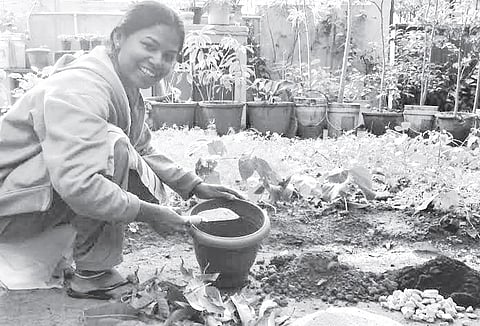

BENGALURU: As an urban farmer, success at container gardening depends on what goes into your containers. Plants nurture themselves by using nutrients and minerals available in the potting mixture in containers apart from water, sunlight and CO2. The moisture content retained in the soil largely depends on the composition of the potting mixture.
Step by Step guide to preparing a container to grow plants:
1Any potting mixture would have three components - red soil, sand and compost. To make potting mixture, these need to be mixed in the right proportion to obtain the perfect mixture that is most suited for plant growth. Most plants thrive well in a 1:1:1 ratio of red soil, sand and compost. The compost could be either homemade compost or farm yard manure. One sack of potting mixture (50 kgs/bag) is sufficient for two containers, which are 12’’ in diameter and 12’’ in depth.
Coir pith could be added as one part of potting mixture which would make it 1:1:1:1 of red soil, sand, compost and coir pith. Adding coirpith to the mixture makes it light and improves its texture. Adding coir pith would also mean that the potting mixture will not be heavy and it will be easier to move the pots around later on.
2The container could be of mud/ceramic, cement or plastic; or it can be grow bags or wooden boxes. Using old or discarded plastic containers to grow plants would work out to be lighter on the pocket and gentler to Earth. It is very important to drill holes at the bottom of any container to drain the extra water from the pot as well as to provide aeration to roots.
3Once the container is ready with the drain hole, add a layer of pebbles/ jelly/ broken ceramic pieces at the bottom of the container and add a layer of sand over it. The pebble and sand layer act together as a filter. They allow excess water to drain away without allowing the washing away of the potting mixture.
4Fill the pot with the above mentioned potting mixture, leaving about 2” space above for mulch.
Mulch could be any dried plant material or organic waste. This layer of mulch would help retain moisture in the pot for a long period of time and also provide nutrients to the growing plants. (Other benefits of mulch were discussed in the earlier series.)
5 Once you are done with this, pour water into the pot. When you water the pot for the first time, add a lot of water! Water your pot until you find some of the water drain out of the drain hole. When this is done all the air spaces between the soil particles would get filled with moisture.
6Now your pot is ready for seeds to be sown and saplings to be planted Introduce beneficial microbes into the soil by applying cow dung, cow urine or any other form of microbial cultures. Once the microbes have been introduced into the soil, the soil comes alive. Healthy and lively soil is the secret to plant’s growth and good harvests.
For more information on urban farming or any other related queries contact nalini@artyplantz.com
