
BENGALURU: What exactly transpired during the high-level meeting at Vidhana Soudha earlier this month that made Bengaluru Development Minister K J George suddenly announce a modified suburban rail system?
George chaired a meeting attended by MP Rajeev Gowda and officials of the Directorate of Urban Land Transport, Rail India Technical and Economic Service, Bengaluru Railway Division and the South Western Railway Zone at the closed door meeting on February 2.
Insiders say one reason for the hurry is the desperation of the state government to get something going on the suburban front.
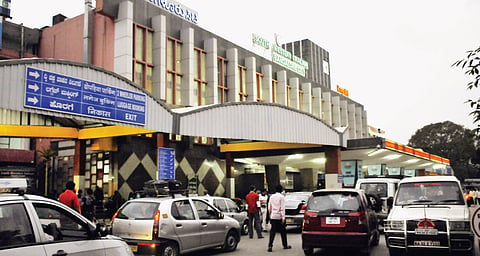
At the meeting, railway officials said the congestion at the Bengaluru City station does not permit the launch of any new services.
The railway budget is slated for February 25, and that left little time for the state government to send in its proposals.
The meeting ended with a consensus to launch Phase I of a suburban rail network to cover three corridors running to 160 km: Tumakuru to Yeshwantpur, Whitefield to Byappanahalli, and Mandya to Kengeri.
H R Rao, General Manager of RITES, said his consultancy group suggested this modified route after railway officials explained the congestion aspect.
“We put forth the Phase I proposal, which costs about Rs 1,000 crore. Funding modalities have to be worked out between the railways and the state government. The suburban rail project originally proposed worked out to Rs 9,000 crore,” he said.
Bengaluru City railway station has 78 pairs of trains running each day, with weekly and biweekly trains adding to the traffic.
“The station is choked. Only a few incremental services can be run from here,” a top railway official told the meeting.
Parking Problem
The Binny Mills land available near the station cannot be converted into a stabling yard (to park trains) for the suburban service because of dimensional contraints, according to officials. “A minimum length of 1.2 km is required to house a train and the land here has a length of only 500 to 600 metres,” an official told City Express. The officials also made it very clear that it was not feasible to run more trains from Bengaluru City station unless infrastructure was upgraded in a big way. “We have no problem with the proposed suburban routes as they bypass the City station,” another railway official explained. The RITES report on the three corridors is regarded as a preliminary step and they have to come up with an indepth report.
Will Take Time
Even the modified version is not going to be executed overnight. “After the final report is presented, the project sanctioned and funds arranged, it takes a minimum of a year to put in place the infrastructure required for Phase I,” said a top railway official. Bearing all these factors in mind, it might take up to late 2017 or even 2018 for the first suburban train in Phase I to begin operations. “Yeshwantpur infrastructure has to be upgraded, stabling lines need to come up at Yeshwantpur as well as Heelalige railway stations, and automatic signalling systems need to be created between Whitefield and Byappanahalli,” the official said.
Three Corridors
The February 2 meeting ended with a consensus to cover three corridors running to 160 km: Tumkur to Yeshwantpur, Whitefield to Byappanahalli, and Mandya to Kengeri. Phase I of the project costs about Rs 1,000 crore.
Higher Fares
Passenger trains result in a loss of Rs 40,000 crore annually. This project should not end up adding to the losses, an official said. Phase II of the suburban rail service may consider linking the routes to the City station or Yeshwantpur, as suggested in the original plan by RITES. This involves nearly 420 km linking Bengaluru to Tumakuru, Mandya, Hosur, Bangarpet, Chikaballapur, Dodaballapur and Nelamangala. Another official said, “A dedicated track for the suburban rail service, like in Mumbai, is really what we need.”
