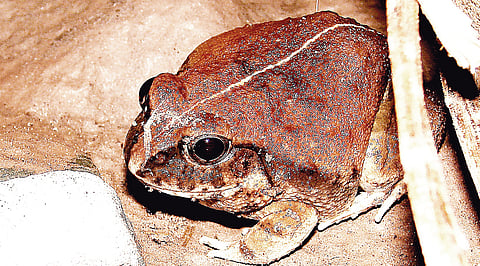

BENGALURU: Have you wondered why you don’t see frogs as often as you once did?
Research conducted by Dr Gururaja KV, chief scientist at Gubbi Labs, says pollution levels have wiped out many frog species in the city. Three of the 17 species of frogs that were once found in Bengaluru can now be seen only in the outskirts.

Gururaja names them — Sholiga Narrow-mouthed frog, Indian burrowing frog and Indian tree frog. Two other species — common skittering frog and common Indian toad — are still surviving the imbalance because they are hardier, says the academic who studies amphibian behaviour.
Worldwide, there are 7,500 species of frogs and 2,500 are on the verge of extinction.
Frogs are bioindicators. Studying their population helps us track ecological health. In short, if they are dying, our environment is sounding an alarm.
This is because frogs are sensitive. “They breathe through their moist and permeable skin that takes in toxins easily. These qualities make frogs vulnerable to environmental disturbances,” says Gururaja.
Though his research speaks about how industrial pollution and urbanisation are affecting frogs, he says, it will soon reach us. “Amphibians are simply the first to be affected,” he says.
The major pollutants from the environment that affect them are nitrate, phosphate and heavy metals such as lead, mercury and zinc which are present in the water. “This can damage the developing embryo of amphibians and thereby reduce their population,” he says.
In humans, nitrates can cause shortness of breath in infants, developmental disorders and even cancer. Heavy metals like lead can accumulate in the human body over years and symptoms might not show until the levels are dangerously high. In infants and children, lead poisoning can cause learning disabilities and stunted growth, while in adults, the consequences range from headaches to memory loss, reduced sperm count and even miscarriage.
The pollution causing reasons in Bengaluru, as across the world, are urbanisation and use of chemical fertilisers and pesticides. They wear the skin off the frogs, which compromises their immunity and leads to them contracting a fungal infection called chytridiomycosis.
He elaborates on their loss of habitat and toxic waters: “The number of buildings, IT parks and industries built on lake beds and green patches have taken away their habitat. Industries also affect the frog before they are born as frogs lay their eggs in water and chemical fertilisers and pesticides that run into the water enter the embryo. That leaves the infant frog handicapped or just kills it before it is born. Third reason that is chytridiomycosis, which is fatal for the frog, because chemicals seep into their body. All of this combined is killing their populations,” says the scientist who has been researching the topic since 1998.
How can the pollution levels be brought down? Shobha Rander, member of Bangalore Eco Team, says that the pollution level in Bengaluru increased from 2012. This might be due to the traffic increase in the city and also buses and other large vehicles that emit smoke. Cutting of trees is another reason for it. “Like we do pollution test for our vehicles, regular pollution testing has to be conducted even for the large vehicles like buses. That will reduce the air pollution levels,” she says.
Dr Jai Prakash Alva, member, Karnataka State Pollution Control Board, says pollution levels fall during monsoon. “We will be requesting the state government to ban diesel vehicles that are over 15 years old.” There will also be stringent pollution checks of vehicles, he says.