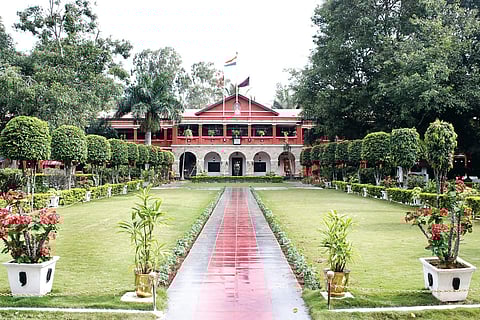

BENGALURU: The Madras Engineer Group known as the Madras Sappers, located at the Promenade Road, has a centuries-old history. This regiment was named in 1780, though it was functioning even earlier, and it moved several locations before settling in Bengaluru in 1865.

Assaye Lines and Meanee Lines
After defeating the local rulers, the British established several cantonments and named them after battles in which they emerged victorious, such as the Assaye Lines (extends from Lavanya Theatre in Ulsoor to Cox Town) and Meanee Lines (in Ulsoor, along Old Madras Road). The MEG regiment functions from these two cantonments.
The Battle of Meanee, between the British and the Talpur Amirs of Sindh, took place in 1843 at Miani (Meeanee) in Sindh, currently in Pakistan. The Assaye Battle was fought between the Maratha Empire and the East India Company in 1803. Nearly a century later, in 1910, an order was issued renaming the Headquarter Lines as Assaye Lines. The two battles were turning points in expansion of the British Empire.
While setting up cantonments, special attention was given to health and sanitation as Indian weather and conditions were considered harmful for British soldiers. Bullock and horse carts were the only means of transportation and a horse cart, the Gwalior Tanga, was presented by the Gwalior Maharaja to the British. In 1903, a light military railway, the Decauville Train, was allotted to the Madras Sappers. The railway line connected the Assaye Lines and Meanee Lines and ran till 1968. The engine of the train stands in front of the regiment’s museum today.
The Monkey House
The Monkey House was made the headquarters in December 1934. Lieutenant Colonel E Bradney was the Commandant of the regiment then.
The building derived its name after a funny observation by an ex commandmant, General Steedman. He had narrated, “In those days there were many monkeys on the trees around the building, chattering all the time. We were only a few people inside the building. We were the minority and our voices would be inaudible. Hence, we decided to join the majority.”
The headquarters initially occupied a building in Assaye Lines, till 1925-26.
The present building, in the Meanee Lines, was formerly a one-storeyed construction and was used as the armoury of the training battalion (guard room), with company offices at the two ends.
The façade has remained unaltered to date. The second storey where the headquarters is now located was constructed and occupied in December 1934 when Lieutenant Colonel E Bradney, DSO, OBE, was the commandant.
There are two wings in the building – one with offices and Zojila Hall, a conference hall, and the other has a record office. These were added to the Monkey House in 1955. An officers’ Tea Room was also constructed and inaugurated in January 2000.
Officers Mess
The building was occupied in 1886 for a rental of `80 per month and, in 1920, it was acquired by the government for `80,000.
Over the years, tennis, badminton and squash courts, porch and Nissan huts for temporary accommodation, VIP guestrooms, bandstand and library were also added. The book The Madras Sappers, An Eduring Legacy, states that the exotic trees that line the front of the building were brought from the East Indies in 1903. In 1954, tree plantation and remodeling of the garden commenced under the guidance of Herv Krvinbeigal, an architect from West Germany.