
BENGALURU: Sai Rahul, a student of Class IX with Daffodils Concept School in Sindhanur, Raichur comes from a family of farmers. His father and his grandfather have been tilling the land ever since he can remember. One of the major problems faced by people in this part of the state is water laden with pesticides and chemicals.

“We have a lot of lakes here in which people rear fish and prawn as a side business along with farming,” says 14-year-old Rahul. “However, farmers spray a lot of fertilisers containing phosphates and nitrates, on their crop. When it rains all these get washed down into the lake and seep into the groundwater.”
Phosphates become toxic when present in high levels in water, causing digestive problems. High concentration of phosphates in a water body can speed up its aging and harm its surface water ecosystem because of an imbalance in nutrients.
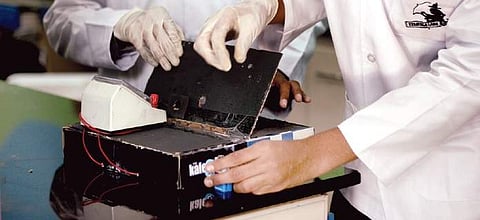
Somewhere at the back of his mind, Rahul always wanted to solve this problem. An opportunity was provided to him at a workshop organised in the city recently by Eureka, a hands-on science education provider. He and his classmate Girish, who also comes from a family of farmers, have designed a cheap and accurate Colourimeter to detect such substances.
Currently, there are many solutions to this problem in the market. One method is called the ascorbic acid method.
However, the cost is quite high. “In general, to detect the level of phosphates, a test would cost `7,000. A farmer with a small holding can hardly afford such a price,” he says. “We therefore wanted to make a device that will cost only `500. It’s small, handy and lightweight.”
He admits that his device is not revolutionary but is a marked improvement that will be beneficial for farmers. “The same principle of any colourimeter is used but with materials that are cheaper.”
Rahul and Girish now want to take things to the next level and commercialise their product and bring it to the market.
“I am very sure that we will help farmers with this device,” he says.
“Many of them are poor and cannot afford expensive devices. We are working to improve our device in such a way that it shows reading about the level of chemicals automatically once placed in water. We will complete these improvements in a month.”
Theirs is one of 19 other teams who will be groomed over the next three years to participate at the the Google Science Fair (GSF) and Intel Science and Engineering Fair (ISEF).