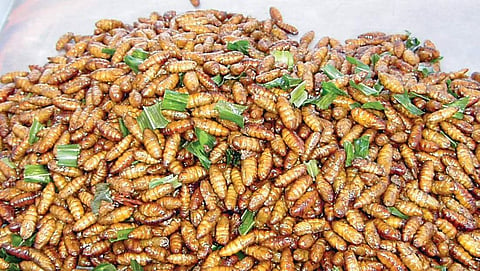

BENGALURU: What are the first things that come to mind when you think of insects and bugs? Shrieks and creepy images from films?
Now imagine eating these creatures as food. Ask any entomologist and they will tell you that insects are a good and eco-friendly source of proteins and nutrients when compared to poultry and other kinds of meat. However, due to taboos and ignorance, just the thought makes people cringe. Not many people know about their dietary benefits.
The National Bureau of Agricultural Insect Resources (NBAIR) in Bengaluru and two other institutes are currently researching the possibility of promoting insects as food for humans and feed for animals as part of an ongoing project that started late last year called, ‘Studies in the Utilisation of Insects as Food and Feed’

“Insects have a great potential to be used as food for humans... though one cannot go directly promoting this in a country like India. There is a lot of taboo attached to it, especially with many here being vegetarians,” says Dr Kesavan Subaharan, Principal Scientist, Division of Insect Ecology, NBAIR.
Fried Termites and Crickets in Chocolate
While insects are a popular source of food around the world such as in Africa, Latin America, and many Asian countries, its popularity in India is only in certain pockets. In Karnataka for example, a popular traditional dish in certain parts of Chikkamagalur is the red-ant chutney.
Certain communities in Salem, Tamil Nadu, eat a certain species of termites by frying them in oil. The practice of eating insects is however probably most widespread in the Northeast Indian states. For example, the Eri silkworm is a delicacy in many states such as Manipur and Nagaland. According to a research study published last year, Arunachal Pradesh has at least 158 species of insects that are consumed. In Nagaland, there are around 42 species of insects that are regularly eaten. The NBAIR project aims to find more such practices and encourage it.
BBQ Larvae, Anyone?
Dr Subaharan explained that insects could be used as common snacks with the addition of some other food item. In a number of etymology departments of US universities, for example, insect snacks are popularised through food shows, he adds. “Even in the US, insects food is still not very popular and they engage in regular promotions and extensions.
One can popularise insect snacks in combination with chocolates and other common flavours. It can definitely add value to such insect-based food products,” he says. In the same vein, Dr U Amala, Scientist (Entomology) and, principal investigator of project, says that more insects can be identified that can be used as insect powder to go along with food similar to the powder chutneys used in North Karnataka. “Red ants have the potential to be made into processed foods. Other uses can be as flavouring like in ice cream. The scope of insect products is endless,” she adds.
Cheaper Animal Feed
With regards to animal feeds, the NBAIR is trying to find out about the insects that can be cultured in labs. The black soldiers fly, some species of the housefly and larvae sources are being considered. “The black soldiers fly can easily multiply in any kind of waste. They can be grown in relatively small areas. In fisheries, 50 per cent of production cost goes on feed cost. This can be considerably reduced if insects are used,” she says.
Work in Progress
At an advisory meeting of the NBAIR held last year, it was agreed that there was a need to promote insects as a food and feed source. Soon after, the institute undertook a pilot study to find out how this should be done. Currently, the process of research is being carried out. They are collaborating with the National Institute of Animal Nutrition and Physiology and the Central Inland Fisheries Institute for the project. Dr Amala says: “We are presently in the process of documenting insects that can be used as food and feed. The different species that are edible, economic significance, and many other aspects are being looked at.”