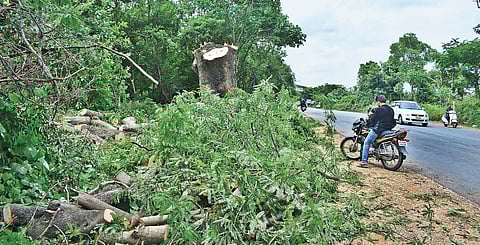

BENGALURU:An urban forest like Bannerghatta National Park (BNP) is must for a city like Bengaluru which is facing rapid urbanization, development of massive transit infrastructure projects and disappearance of green spaces. Research findings at the Indian Institute of Human Settlements say the protection of Bannerghatta’s buffer zone which is the Eco-Sensitive Zone (ESZ) is crucial as it will reduce the ecological footprint, heat island effect, rising pollution and psychological stress among citizens.
However, India’s largest protected urban forest— the Bannerghatta National Park stands to lose one-third of its buffer zone once the second revised draft of the ESZ is approved by the Central government. This is expected to lead to more urban development especially in the peripheral village of the BNP, severe fragmentation of its corridor and increased man-animal conflicts in the coming days.

The second revised ESZ draft sent in April this year excludes 147 villages from the ESZ while the extent stretches from a meager 100 metres near the expanding villages to 4.5 kilometres in the southern fringes of the park. Further, it includes just 16 revenue enclosures while leaving all the 147 villages.
The research study done by Siddhant Nowlakha, Urban Fellow, Indian Institute of Human Settlements reveals that there has been a brazen exclusion of a large extent of the buffer area from the revised draft of the BNP. This research analysis was carried out when 77 villages were included in the draft ESZ. The key findings have shown how very high eco-sensitive villages were excluded and those that were included were given perfunctory 100 metres extent.
Shrinking Esz Area A Cause For Concern
“The buffer zone of the BNP is an important issue for Bengaluru - one that should attract public awareness, especially now when ESZ boundary is sent to MoEF&CC for approval,” says Nowlakha.
With neither the public nor the stakeholders submitting any objections to the inclusion of 77 villages in the buffer zone, the report states, “There was a stunning reduction in the ESZ area from 268.96 to 181.57 square kilometres by the state government. In fact, a 2016 study by CES, Indian Institute of Science is one of the most comprehensive analysis of Bannerghatta buffer zone which was initially supported by the forest department but later ignored when forming the ESZ area.”
Bnp A Unique Heritage Site
Researcher Nowlakha stresses the core principle of the ESZ is to maintain a contiguous corridor for wildlife and minimizing negative and anthropogenic effect on forests. Forest officials view the implementation of the ESZ difficult, cites the report and concludes, “Other departments and politicians should be involved. The BNP is at the edge of a growing city like Bengaluru... ..BNP is a unique heritage site for Bengaluru and this alone should shake rest of the government - not just the forest department but also other departments to partner in its conservation and help consolidate its buffer zone.”
Transit Projects To Impact Buffer Zone
Bangalore Development Authority’s (BDA) plans to develop peri-urban areas too will have a direct impact on the BNP’s buffer zone which lies at the southern edge of Bangalore Metropolitan Area. There has been large-scale developments in Hosur and Kanakpura Roads as also the Jigani-Anekal Road, the research finds. There are at least three large-scale transit projects planned in the city - the four-laning of Kanakpura Road, the Red Line of Namma Metro line from Nagvara to Gottigere and the suburban rail project linking satellite towns like Ramanagara and Bidadi that will substantially change the land cover and land use dynamics around the park.