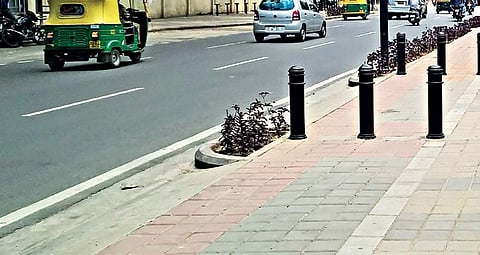

BENGALURU: Although TenderSure roads were conceptualised for retaining the green spaces and compensating for the greenery lost, the host of roads that have been completed, does not demonstrate this. The city’s green experts say road planners seem to have neither consulted tree experts nor planted the right/suitable species on these hi-tech expensive roads. With greenery gone from the roads, new trees will neither come up nor thrive.
Both experts and activists threaten to begin a stir on this issue as they say there is no emphasis on green spaces while many avenue trees were removed from most of the TenderSure roads. Further, forest experts add that wrong tree species have been planted on these roads as a result of which they have died. Palm trees that have been planted on these roads, grow only in gardens and parks but the road planners decided to plant them on streets and one can see the result — while some have died, others are in the process of dying.

THE CHURCH STREET STORY
Take the case of Church Street: Here, two massive trees — one, a Jacaranda tree in front of K C Das and another species, a Copper Pod tree in front of Karnataka State Pollution Control Board — were chopped for the project. Presently, on this street, one can see greenery only on the private lands or inside houses adjoining this road which hardly provides shade or shelter to people. Further, if one has to speak about the condition of the Palm trees that were planted here — the less said the better.
Suresh, a regular visitor to this area says, “Today, Church Street looks bare and dusty — bereft of its verdant green cover. Apart from this, the maintenance of the road is also poor. Even after spending crores on the project, I don’t see much of a difference when compared to other roads, except the fancy tiles and wider concretised footpaths.”
GREEN COVER LOSS
Transferred from Tirthahalli to Bengaluru in 1982, the forest officer who turned the city green, took up an urban forestry scheme that comprised innovative techniques and planting a mix of flowering, shade, fruit and ornamental tree species. Well known Retd IFS officer S G Neginhal — responsible for the greening of Bengaluru in the 1980s by planting 15 lakh saplings — says, if 10 per cent of this green cover has been lost due to Metro and road-widening projects. The TenderSure project may result in loss of another 10 per cent if corrective measures are not taken with more roads in the offing.
Till date, there has been no compensation for the lost greenery, says Vijay Nishanth, tree doctor and urban conservationist. He adds, “The designing of the TenderSure roads is very bad as unsuitable species have been planted. Also, there is no compensation for the trees that were chopped on every road under this project.”
WHERE DID THE PLANNERS GO WRONG?
The planners have no knowledge of trees and species that have been planted on these roads, says S G Neginhal. “Further, they have no expertise on planting too. After big trees were chopped on these roads, they are planting unsuitable species in pits that are as small as nine inches with no depth. How will the trees thrive in insufficient space and depth? For example, Palm trees cannot be planted on streets as they thrive only in gardens and parks.”
Further, the TenderSure designers seem to be concentrating only on ornamental and show species while the city roads desperately need shade giving species. Neginhal adds, “Not just wrong planning, it is utter foolishness on their part to plant big species in insufficient pit size and depth that widen up in girth and result in tightening of concrete surroundings. A right mix of ornamental and shade species could have been selected and planted depending on the road width and the depth available.”In the days to come, these concrete roads may become heat islands bereft of the green cover and people may find it difficult to walk here, the city’s the green expert said.
FAULTY PLANNING