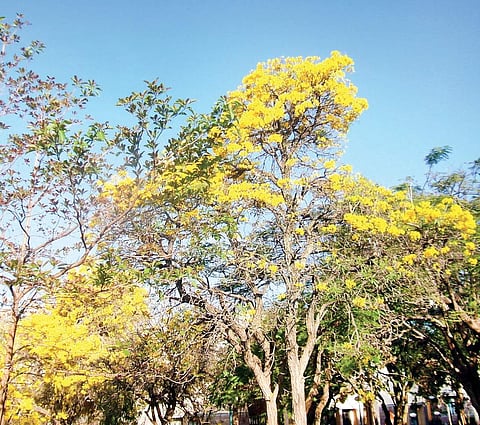

BENGALURU: The Horticultural Nursery and Garden at Indian Institute of Science (IISc) is maintained by a team of gardeners and overseen by horticulturist B Sridhar. The plants in the nursery make an eclectic collection that include orchids and aroids, begonias, bonsai ficus trees and Thunbergia mysorensis climbers. This season the flowering plants bloom, and it is a treat to see.
An Annual Founder’s Day Flower Show is organised at the nursery on the first week of March, a tradition that first began probably in the 1950s.Ornamental flowering plants are lined up in the quadrangle of IISc’s main building. Gardeners starts preparing for the show every December. A variety of seeds (harvested from the previous year’s show) and fresh seeds purchased from several horticultural agencies in the city are sun-dried and planted in rows of pots. The blooms appear around the third week of February. By March 1 every year, the pots are transported from the Horticultural Nursery to the main building, where the gardeners put up a display to coincide with the Founder’s Day celebrations on March 3.
Common name: Flaming torch, Summer torch
Scientific name: Billbergia pyramidalis
Family: Bromeliaceae
Native to Brazil, Venezuela, French Guiana, the Lesser Antilles and Cuba, these plants are adaptable, growing well as a terrestrial or epiphytic plant. The flowers last less than a month. Nearly all of the plants bloom at the same time in the late summer and they bloom more frequently in some latitudes.
Common name: Fish poison tree, Sea poison tree
Scientific name: Barringtonia asiatica
Family: Lecythidaceae
A species of Barringtonia, this plant is native to mangrove habitats on the tropical coasts and islands of Indian Ocean and western Pacific Ocean. A sickly sweet smell emanated by its pinkish-white pompon flowers attracts bats and moths for pollination at night. The fruits are lantern-shaped and float on water.
Common name: Rose
Scientific name: Rosa
Family: Rosaceae
A woody perennial flowering plant rose belongs to the genus Rosa, in the family Rosaceae. There are over a hundred species of the plant. The name is derived from French, itself from Latin rosa, which was perhaps borrowed from Oscan.

Common name: Spider flower, spider plant, or pink queen
Scientific name: Cleome hassleriana
Family: Cleomaceae
Native to southern South America, it grows to a height of 150 cm (60 in). The flowers are purple, pink or white with four petals and six long stamens .
Common name: Bronze shower tree
Scientific name: Cassia moschata
Family: Fabaceae
This tree blooms in February and March every year. It has bunches of pendant like flowers that are orange-copper-yellow coloured and that cascade downwards, giving it the name bronze shower tree. Native to places with warm climates, cassias yield a variety of products such as fodder, timber and medicinal drugs.
Common name: Hollyhock
Scientific name: Alcea rosea
Family: Malvaceae
The ornamental plant was imported into Europe from southwestern China during, or possibly before the 15th century. It is said that a herbalist of that time William Turner gave it the name ‘holyoke’ from which the English name was derived. The plant is described as biennial, annual or a short-lived perennial. It may flower during its first year when sown early. It grows in a wide range of soils and can easily reach a height of about 8 feet. The colours of the flowers vary from white to dark red, depending on the kind of soil it grows in.
Common name: Match Stick Plant, Gamos Bromeliad
Scientific name: Aechmea gamosepala
Family: Bromeliaceae (Pineapple Family)
The flower looks like pink match-sticks with bright blue heads and hence the name match stick plant. It is known for its beautiful foliage, long lasting colour and vivid berry-like fruit.
Common name: Golden bell, silver trumpet tree
Scientific name: Tabebuia aurea
Family: Bignoniaceae
A beautiful showy tropical flowering tree, Tabebuias are small, 15 to 25-foot tall evergreen trees, they are often called Trumpet Trees. They have silvery foliage and deeply furrowed silvery/corky bark. They put on a great display with a multitude of two to three-inch-long golden yellow, trumpet-shaped blooms, marking the onset of Summer.
Common name: Bougainvillea
Scientific name: Bougainvillea glabra
Family: Nyctaginaceae
Philibert Commerçon, an European botanist, was the first to describe Bougainvillea during his voyage of circumnavigation of the Earth with French Navy admiral and explorer Louis Antoine de Bougainville. The flower got its name after this French explorer. The plant is a genus of thorny ornamental vines, bushes, and trees with flower-like spring leaves near its flowers.