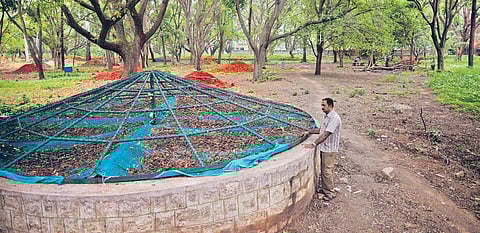

BENGALURU: An ambitious project started in May last year to bring back to life the once-ruined open wells of Cubbon Park are showing promising results just a little over a year later. These wells revived to encourage Bengalureans to be part of the ‘Million wells campaign’ are a testimony to the benefits of rainwater harvesting.
Over 80,000 litres of water are generated from the seven wells (of which one is only used for the Karaga festival) every day in Cubbon Park. The initiative was started by S Vishwanath, rainwater harvesting expert from Biome, Ramprasad, founder of Friends of Lakes, India Cares Foundation and 15 well-diggers from the traditional Bovi community.

“The 30-foot deep open wells are doing great in Cubbon Park, giving us a total quantity of 80,000 litres per day. We wanted a proof of the concept to encourage citizens to be part of the ‘million wells campaign’. The seven of them are interconnected as a part of Phase one. We have got permission from the Horticulture department to go ahead with Phase two and are currently gathering funds,” said Ramprasad.
As part of the second phase, around 40 to 50 recharge wells will be dug. “These are different from open wells. These are smaller and about 10 to 15 feet deep.They will help recharge and keep the open wells alive. The upcoming phase will also include rejuvenating exisitng ponds,” he shared, adding that the recharge wells will be needed to supply water to the ponds too.
The recharge wells, placed on a higher level, will be interconnected with the open wells. The rainfall that Bengaluru receives will go into the underground aquifier. Phase two was meant to start earlier but got delayed because of the elections, the members of the initiative said.
Now work is expected to begin from October 15 for the recharge well construction and will take two months to complete. As for the ponds, work will start in May 2019 when the ponds are naturally dry. “This is not a project, as much as a movement to make people aware of the benefits of wells and the policy of rain water harvesting. What we are doing in Cubbon Park is merely a demonstration, to show people how successful it is. It is up to citizens to take it forward now. We believe that if there are one million wells in the city, Bengaluru will be water secure,” said Vishwanath.
Deputy Director of Cubbon Park, Mahantesh Murgod, said,“This project has been a success though it has started more than a year ago. Earlier, the well water was dirty with garbage thrown inside. They were not connected to each other either. Now we have clear water, which we use to maintain the 300-acre odd lung space.”
“We are pumping out 50,000 litres per day to water trees in Cubbon Park and to the rose garden too. We are not even using the wells to their capacity now, and will need it more during the summers when there is no rainfall. In addition, we use the treated sewage water sent by the BWSSB's STP (Bengaluru Water Supply and Sewerge Board, Sewage Treatment Plant),” Mahantesh added.
Science behind interconnection
The interconnection of the recharge wells with the open wells has a scientific explanation to it.“When there is water in particular area, it attarcts water from surrounding areas. This is known as capillary effect. The recharge wells will be built in such a way that, once one gets filled up, the water will overflow into the neighbouring well,” says Ramprasad, adding that interconnecting wells is also the solution to prevent flooding on roads.
How are lawns watered?
Every well has a pump that is connected to a centralised pump. Water from the open wells is currently pumped out, in order to water the lawns.