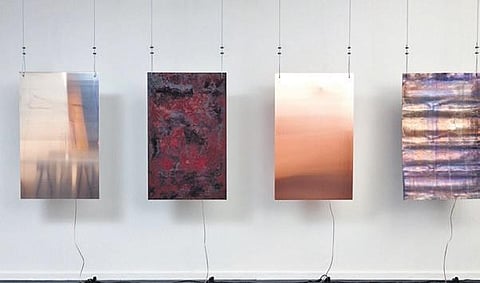

BENGALURU: According to the government of Karnataka, 2019 is the ‘Year of Water’. And anyone who resides in Bengaluru is aware of how water is one of the most urgent concerns not just of the city, but of India as a whole. Which is why, Science Gallery Bengaluru decided to hold a full exhibition-season, as it made sense to focus on the liquid.
Titled Submerge, the exhibition aims to explore the collective experience of water in everyday life and reflect on the future challenges we have to confront. Dr Jahnavi Phalkey, founding director, Science Gallery Bengaluru, says, “Research-based public engagement can make a difference in the way we think about water and can nurture understanding and new appreciation for this liquid.”
Submerge features 12 transdisciplinary exhibits, which were shortlisted from an open call of 130 proposals from around the world. A key feature of the exhibition, explains Phalkey, is ‘circular programming’ or put simply, to also display the process behind the creation of the work. “The excitement lies, among other things, in the fact that we have artists and scientists exhibiting in the same space. We want the audience, especially young adults, to go beyond viewing, to engaging, by doing masterclasses, workshops, tutorials in art, science and humanities to address their own concerns,” says Phalkey, who is also a historian of science, and a filmmaker.
For example, the video exhibit – the Terra Mars series by SHI Weili – presents artistic satellite images of Earth and Mars using artificial intelligence. The views of Mars are based on neural network models generated from Earth’s topographical data, and vice versa. “So, these images can be interpreted in multiple ways, such as a playful remix of planets, a preview of terraformed Mars, or a dystopic future of Earth,” says Phalkey. Young adults can also check the ‘Water on the Red Planet’ workshop with a speculative fiction writer, a hydrologist and a physicist. Two other workshops, ‘Deep Dive’ and ‘Shape of Water’, will teach them how to use open-source data to map water sources and make new discoveries around water.
Similarly, Diagenesis by Ivan Macera uses water to explore the internal structure of stones. Phalkey explains, “When dehydrated stones are placed in water, they act like a sponge and absorb this water, creating unique hissing sounds. This sound anatomy becomes the voice of the stones, thus decoding a memory older than humans.” The exhibit, thus, will allow viewers to engage with the piece through a performance by Macera, where he will create music using these recorded sounds. “Several exhibits have live data input, physically grow and change in the duration of the exhibition-season, and anchor creativity beyond disciplines,” adds Phalkey.
The exhibition will also feature the travelling exhibition ‘H2O Today’ from the Smithsonian Institution Traveling Exhibition Service (SITES). The Smithsonian Institution, alongside the Museum of Art and Photography (Bangalore) are content partners for this exhibition-season.
Submerge will take place till Jan 30 at BIC.
