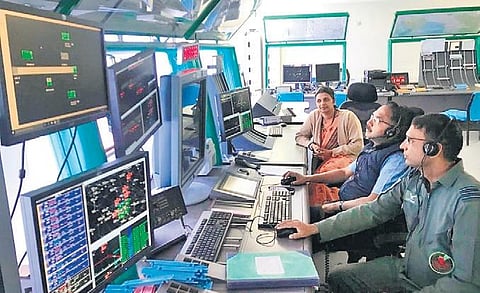

BENGALURU: In order to facilitate simultaneous operations from Yelahanka air base and Kempegowda International Airport (KIA), the Indian Air Force (IAF) has taken a major initiative to co-locate IAF radar controllers with the Airport Authority of India (AAI) radar controllers at KIA. This will be the first time in India that military and civil radar controllers are being co-located for providing radar control services within the respective airspaces, a defence release said.
Co-location will facilitate dynamic co-ordination between the two controllers, which will not only enhance safety of operations, but also ensure that the second runway at KIA is used to its full potential. IAF conducts flight training for rookie pilots using IAF transport aircrafts and helicopters at the Yelahanka Air Force Station, which is in KIA’s neighbourhood.The close proximity between the airbase and KIA’s new runway requires aircrafts from both airfields to fly accurately to ensure that the specified minimum radar separation between two aircrafts is not infringed upon.
A joint working group (JWG) was constituted by the Ministry of Civil Aviation (MoCA) comprising its own members, apart from those from the Indian Air Force, Airport Authority of India (AAI) and Bengaluru International Airport Limited (BIAL)to formulate procedures for safe conduct of operations without compromising on civil/military operational requirements at both airports.
The JWG had several meetings in the past few years to gradually evolve safe operational procedures, ably supported at the apex level by Air HQ and all stakeholders.KIA is among the fastest growing airports in the world, and it is estimated that 65 million passengers per annum will use the airport as a transit point by 2024-2025.The second runway, made operational on December 6 at KIA with the active support of Indian Air Force, is key to handling the forecast growth of civil aviation.
IAF has been in the forefront in all discussions with a positive approach to sharing of airspace, co-location of radar controllers and formulation of safe procedures. IAF had also transferred a large portion of its airspace to KIA earlier to facilitate the operationalisation of the first runway at the airport.
