
BENGALURU: He murder of rowdy-sheeter and Tulu actor Surendra Bantwal is the recent and hopefully the last in the trilogy of murders related to the underworld in coastal Karnataka since September this year.
Surendra was hacked to death at his apartment in Bantwal in Dakshina Kannada district on October 21. The police arrested nine accused. According to official sources, Akashbhavan Sharan, one of the main accused, who is already lodged in Bengaluru Central Prison in another crime, had reportedly pooled in his friend late Kishan Hegde’s associates to finish off Surendra to avenge the latter’s killing. Sharan is an associate of underworld gangster Vicky Shetty.
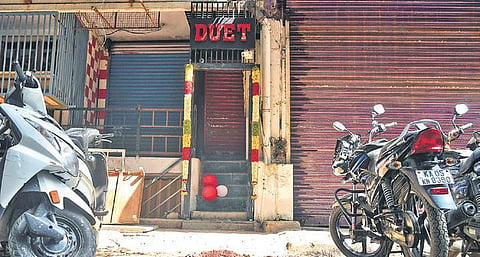
Hegde was killed on September 24 in Udupi by his former friend-turned-foe Manoj Kodikere and his associates over money matters. The accused were arrested in the case. In between, on October 15, another former rowdy-sheeter and associate of extradited underworld don Ravi Pujari -- Manish Shetty -- was killed in Bengaluru in front of his Duet Pub on Church Street. His rival and former henchman of Pujari -- Vicky Shetty – allegedly claimed responsibility for Manish’s murder to “send a message of his arrival as Pujari’s heir”.
The latter has been lodged in Bengaluru Central Prison since his extradition in February this year. The police dossiers state that Manish and Vicky were at one point the errand boys and sharpshooters of Pujari and at some stage the former had fallen out of favour with his mentor over financial matters. From then on, Pujari had started investing in Manish, who was reportedly running Pujari’s extortion business in coastal Karnataka until the latter’s arrest in the Republic of Senegal. This didn’t go down well with Vicky and he got Manish eliminated, said official sources.
Interestingly, behind the three killings are budding rowdies, who, according to official sources, at some time had allegedly flaunted their identities as members of fringe Right wing groups in coastal Karnataka, though the latter have vehemently denied any association with them. According to police sources, Surendra had identified himself as a gau raksha pramukh (cow vigilante) in Bantwal in the last decade and had come under the police radar.
“There are eerie reflections of Shetty doing a Pujari, who had capitalised on his image as a Hindu don. The fissures in underworld in coastal Karnataka and Mumbai had widened on communal lines, post the Babri Masjid demolition on December 6, 1992 and the subsequent Mumbai riots the same month and in January 1993 in which around 900 Mumbai residents were left dead,” said an officer, who didn’t wish to be named.
The three murders in Karnataka are being seen as Vicky Shetty’s desperate attempts to fit in the shoes of Pujari as the misnomer ‘Hindu don’, who had in February 2016, threatened the former Hurriyat chairman Syed Ali Shah Geelani to not incite Jawaharlal Nehru University (JNU) students and youngsters against the country.
There are consistent attempts being made by the Karnataka police to bring to justice Dawood’s close associate Chota Shakeel’s sharpshooter Abdul Rashid Hussein alias Rashid Malbari, who was assigned to assassinate VIP targets – Varun Gandhi and Sri Rama Sene founder Pramod Muthalik -- by Shakeel. His attempt to abduct a Dubai-based businessman, who was returning to Mangaluru, for a ransom of Rs 5 crore had failed.
Malbari, who was arrested in 2009, had jumped bail in July 2014 and escaped to Bangladesh and from there on to Abu Dhabi on a Bangladesh passport. Pujari had planned to target Malbari, but instead managed to bump off his advocate Naushad Kashimji in February 2009 in Mangaluru, who he had warned against representing Malbari and members of the banned terrorist organisation - Indian Mujahideen (IM). Malbari was involved in a bid to kill Dawood’s rival Chota Rajan in Bangkok in 2000 along with Dawood’s close aide Sayyed Muddassar Hussain alias Munna Jhingada.
A resident of Mumbai’s Jogeshwari, Jhingada was taken to Pakistan by the Inter-Services Intelligence in October last year after a Thai court identified him as a Pakistani national. The communal fissures in the underworld had become evident when in 1993 Dawood had tasked Jhingada to eliminate his arch-rival Arun Gawli, who, however, survived. What happens in Mumbai underworld is echoed in coastal Karnataka because of the coastal stretch along the Arabian Sea, from where it all began.
“It was all about trade, which was with one community predominantly till the other community with Gulf money came in with bigger boats and trawlers. This, added with the Karnataka Land Reforms Act in 1974, had made many people lose their lands and they migrated to Bombay then and set up small hotels and lodges because of their entrepreneurial skills,” said former Intelligence chief Gopal Hosur.
“Soon, these people from coastal Karnataka began to be looked upon as outsiders by the Shiv Sena’s Marathi nationalist ‘Marathi Manus’ propaganda. The migrants from coastal Karnataka needed muscle power and began seeking protection from the likes of Haji Mastan. The Babri Masjid demolition led to a further churning in the underworld and many migrants from the coast found their soil fertile for an underworld on communal lines.
This was cashed in upon by the politicians and political parties, which have always taken help from the underworld to settle scores with rival politicians,” he added. “The underworld is a reflection of society. It only mirrors the social nuances,” said the former director-general of police D V Guruprasad.
