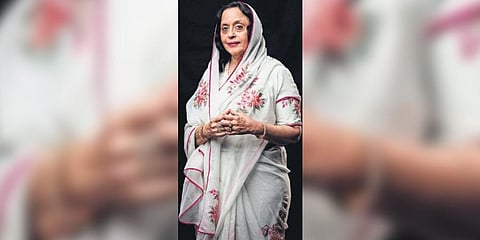

BENGALURU: Around 2012, popular folk singer and Bollywood actor Ila Arun were presented with an unexpected opportunity – to direct a play of her choice for the International Film Festival in Delhi.
Although initially hesitant, Arun was convinced about taking up the director’s mantle following enthusiastic support from her close associates. The creative freedom it offered, to tell the kind of stories that she wanted – ones that gave voice to the voiceless, was also an influential factor in her decision, with her experience in theatre also boosting her confidence.
The result was an adaptation of Henrik Ibsen’s Norwegian play Lady from the Sea, localised and made richer with music.
“Going through Ibsen’s work while deciding which play I should adapt, I realised that a lot of his writings from over 150 years ago are still relevant today. There were a lot of parallels between the protagonist of the Lady from the Sea and that of Indian women, especially the illiterate women of Rajasthan from that period,” she shares. “I used a lot of music, which shocked a few people who couldn’t believe that I had managed to fit so much music into the narrative.”
More than a decade later, Arun has written four original plays and adapted numerous other plays from various parts of the world. Early next month, two of her plays, Baby Blues and Peechha Karti Parchhaiyan, adaptations of an American play of the same name by playwright Tammy Ryan and Henrik Ibsen’s classic Ghosts, respectively, are coming to Ranga Shankara.
Both plays explore vastly different themes, but are similar in the way they tackle societal taboos and social issues. Baby Blues explores a new mother’s descent into postpartum depression, and her relationship with her sensitive husband, while highlighting the challenges of being a first-time mother in the modern world. When she first read the play, Arun says she felt ashamed of her own ignorance of an issue that affects a significant portion of women experiencing motherhood.
“As a mother of a child, I didn’t know what postpartum depression was. When I came to know about it, I was horrified. Young mothers going through the issue are often dismissed as having mood swings due to hormonal imbalances. But it’s much more serious than that,” she says.
Although an adaptation, Arun shares that little-to-no changes were made to the original script. “It covers all aspects of human relationships, and has lighter moments that make the play richer,” she adds.
Meanwhile, Peechha Karti Parchhaiyan (PKP) is a more localised adaptation of Henrik Ibsen’s classic Ghosts. The original explored themes such as religion, infidelity, sexual abuse and much more that were taboo for the time when it was first staged in the 1880s. With PKP, Arun explores the various taboos and religious rituals in an Indian setting, telling the bleak story of an erstwhile royal family that is still living on their past glory, desperately clutching onto old traditions and decrepit lifestyles.
A musician at heart, Arun’s latest plays are filled to the brim with music, woven naturally into each narrative. “While developing the scripts, I realised that a lot of music could be added to further the story, whether as a background score or as part of the story. Music is a strength of mine, so I know what kind of music is suitable for the plays I write,” she shares.
(Peechha Karti Parchhaiyan and Baby Blues will be staged at Rangashankara on April 7 and 8, respectively. Details on bookmyshow.com)
