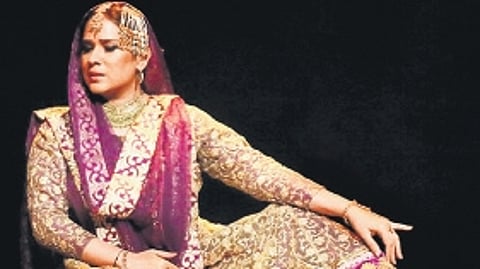

BENGALURU: Be it Madhuri Dixit’s portrayal of Chandramukhi in Devdas or Aishwarya Rai Bachchan as the beguiling Umrao Jaan, there has always been a deceptive connection between seduction and independent women, well-versed in the art of dance and music, also known as courtesans or tawaifs. Now, while the portrayal of these courtesans as women who were mostly ruled by their desires still persists, behind this veil lies a rich history of women who were not only masters in their art but were highly-educated individuals. Many even became actors and singers in Bollywood post-Independence.
This story is not heard often, but one that Delhi-based Manjari Chaturvedi, a renowned Sufi Kathak dancer, has been working to bring to the limelight with The Courtesan Project. With her upcoming performance of Main Tawaif in the city, she seeks to honour the legacy of these misunderstood artistes, integrating years of dedicated research and performance. “A lot of people told me this is professional suicide. They told me to let it go because they are relics of history. But I said they are not part of history because no one knows anything about them. We have removed their names from the history of performing arts. In Kathak, there is no mention of women before Independence because they were all tawaifs and the more I found out, the more angry I became,” shares Chaturvedi, who started this project 15 years ago.
Her meeting singer Zareena Begum in 1999 in Lucknow, when she was just starting as a young dancer was her first encounter with a world she only heard of in stories. “She was a senior singer and when I told her I would like to dance on one of her songs, she looked at me and said ‘You are from such a big family and you will perform on “our” song?’. Coming from educated middle-class backgrounds, we don’t know a lot of things that are stigmatised in our society till we are exposed to it,” she says, adding, “My turning point came when I asked for sponsorship to do a mehfil for Zareena Begum. But they refused because they said they don’t want to be associated with a tawaif. Then it became an obsession for me,” recounts Chaturvedi.
After doing free shows for many years, Chaturvedi has tried to find different ways to reach people. “I did a fashion show for Tarun Tahiliani where I was the showstopper. That helped me reach out to a different audience which otherwise I wouldn’t have,” she says, adding, “For the last 10 years, I have been doing these stories of different courtesans from history like Nawab Jaan and Mirza Ghalib, the tawaif who sang Ghalib. But when I did the fashion show, Tarun asked me if he should introduce me as Manjari Chaturvedi, the tawaif. I hesitated but then immediately I realised that if I don’t accept this, then no one will. That day, the show – Main Tawaif – took shape.”
As part of the performance, Chaturvedi not only dances to the original compositions sung by the tawaifs but also narrates their stories. And as someone who wishes to offer an alternative history and remove the stigma associated with words like tawaif, Chaturvedi says she is disheartened by the ‘surface-level portrayal’ in Sanjay Leela Bhansali’s Heeramandi.
“Such portrayals damage women’s history beyond repair, presenting a distorted narrative,” she laments, adding, “They were known to be great poets. They were women who worked hard for 10-12 years to master a raag or taal. We don’t see anything except scheming or conniving women. Great art and artistes have always changed the narrative and not reinforced a stereotype at such a large scale.”
Main Tawaif will be staged at Bangalore International Centre on May 22, at 7pm